Cost & Pricing
VAT on Takeaway Food in the UK: Hot, Cold, Meal Deals and Delivery
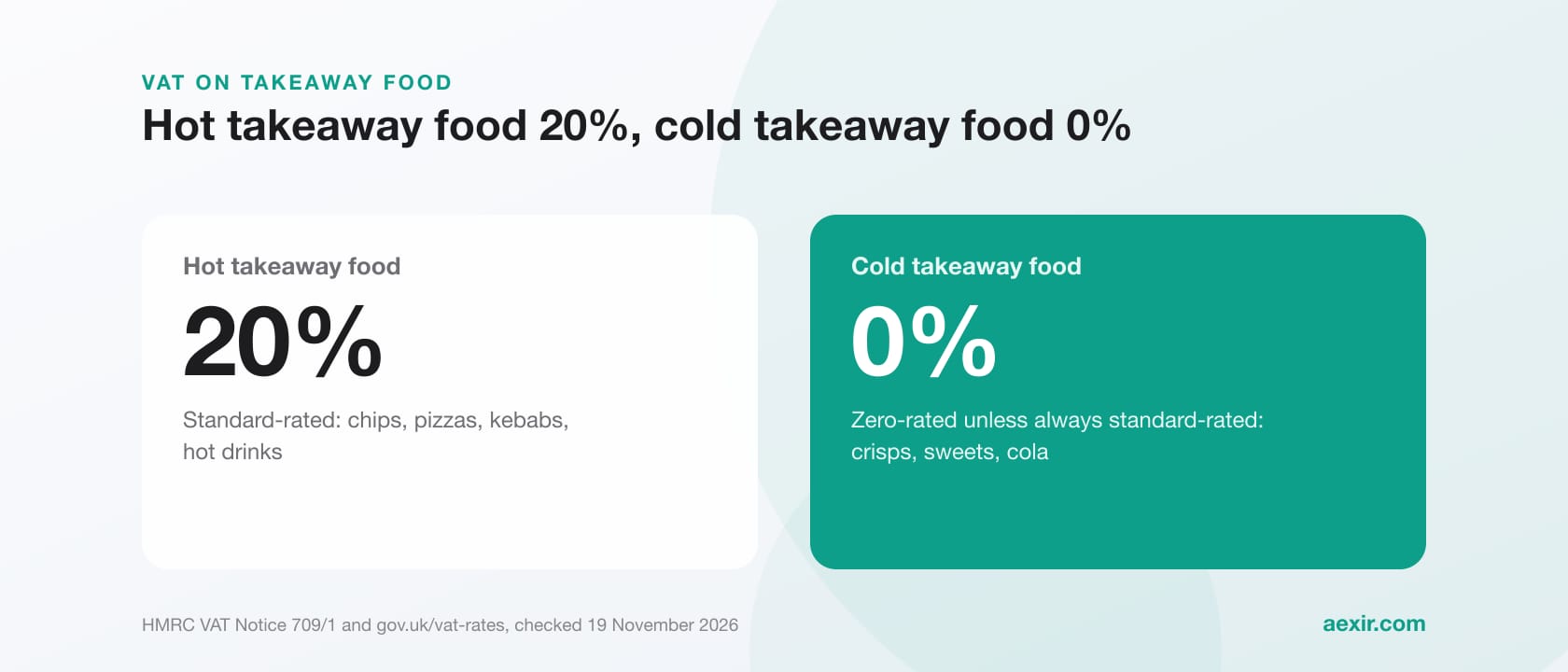
Chart: Aexir, from the figures in this article
For a VAT-registered takeaway, hot takeaway food and drink is standard-rated at 20%, cold takeaway food is zero-rated unless it is a type that is always standard-rated (such as crisps, sweets and bottled water), and food eaten on the premises is always standard-rated (HMRC VAT Notice 709/1, last updated 8 June 2026). You must register once taxable turnover goes over £90,000 in 12 months (gov.uk, Register for VAT). All pages were checked on 19 November 2026.
Short answer: if you are VAT-registered, hot takeaway food and hot drinks are 20%, cold takeaway food is 0% unless it is always standard-rated (crisps, sweets, ice cream, soft drinks, bottled water), and everything eaten on your premises is 20%. A delivery charge follows the food it comes with. If you are not registered, you charge no VAT.
Do takeaways pay VAT?
Only VAT-registered businesses charge it. HMRC's VAT guide says a supply made by someone who is not a taxable person is outside the scope of UK VAT, and a taxable person is one who is, or is required to be, registered (VAT Notice 700, section 3.2, checked 19 November 2026).
Once you are registered, the rate depends on what you sell and how you sell it. Food is usually zero-rated, but food supplied "in the course of catering" is standard-rated, and the standard rate is 20% (gov.uk, VAT rates). HMRC counts three things as catering: catering in its ordinary meaning, food for consumption on the premises, and hot takeaway food (VAT Notice 709/1, section 1.3).
VAT is UK-wide: the notices quoted here make no distinction between England, Scotland, Wales and Northern Ireland.
Is there still a reduced rate for hospitality?
Not for takeaway food. The temporary reduced rate for tourism and hospitality ended on 31 March 2022, and Notice 709/1's update log says that from 1 April 2022 "the normal VAT rules apply, and VAT should be charged at the standard rate".
On 19 November 2026 the notice still carried a banner about a later scheme, a temporary reduced rate on certain children's meals from 25 June 2026 to 1 September 2026. Those dates have passed, the rate was 5%, and HMRC's brief says "Takeaway meals do not qualify for the reduced rate" (Revenue and Customs Brief 5 (2026), updated 27 July 2026).
What counts as hot takeaway food?
Notice 709/1 sets a precondition and five tests (sections 4.2 and 4.3). The precondition: the food or drink, or any part of it, is hot when it is provided to the customer, meaning above the ambient air temperature. The sale is then standard-rated if one or more of these is true:
- It has been heated for the purposes of enabling it to be consumed hot. HMRC's examples: chips, pizzas, kebabs, Chinese and Indian takeaway meals, tea and coffee.
- It has been heated to order, such as toasted sandwiches and panini.
- It has been kept hot after being heated: heated cabinets, heat lamps, hot shelves, a doner kebab on a spit.
- It is provided in packaging that retains heat, or packaging specifically designed for hot food, such as foil lined bags and containers or pizza boxes. Ordinary paper bags do not count.
- It is advertised or marketed in a way that indicates it is supplied hot. Advertising it as "freshly baked" does not count.
Food that is only warm because it is fresh from the oven can stay zero-rated. HMRC's example is a Cornish pasty left to cool naturally, sold in a standard paper bag and advertised as freshly baked: no test is met, so it is zero-rated. Keep the same pasties under heat lamps and they become standard-rated (section 4.4).
Hot food with a cold ingredient sold as a single item is standard-rated as a whole. That makes bacon sandwiches, chip butties, kebabs and baked potatoes with a cold filling all 20% (section 4.6).
Which cold takeaway food is zero-rated?
Cold takeaway food and drink is zero-rated "as long as it’s not of a type that’s always standard-rated" (Notice 709/1, section 4.1). The always standard-rated items are in VAT Notice 701/14, section 2.2: ice cream and similar products, confectionery apart from cakes and some biscuits, alcoholic beverages, other beverages, and potato crisps, roasted or salted nuts and some other savoury snacks.
"Other beverages" includes cola, lemonade and bottled water. Milk and flavoured milk drinks, including milkshakes, are on the zero-rated side of the list, but only cold and only to take away: the notice says all hot beverages, and any drinks sold for consumption on your premises, are standard-rated (section 3.7.2).
Eat in or take away: what counts as your premises?
Food and drink for consumption on the premises is always standard-rated, hot or cold (section 3.1). The same cold sandwich is 0% taken away and 20% eaten at one of your tables.
Premises means more than the shop floor. HMRC defines it as the areas occupied by the food retailer, or any area set aside for the consumption of food by the retailer's customers, even if other retailers' customers use it too (section 3.2). Its examples include chairs and tables outside a high street outlet and shared food court seating, but not general public seating such as benches in a shopping centre.
If you sell cold food both ways, you need to apportion sales between eat-in and takeaway. If you cannot tell at the point of sale, keep evidence that supports "a fair and reasonable apportionment" (section 3.3).
VAT rates for common takeaway items
| Item | VAT rate | What decides it |
|---|---|---|
| Hot pizza | 20% | Heated to be eaten hot, sold in a pizza box: 709/1, section 4.3, tests 1 and 4 |
| Hot chips, fish and chips | 20% | 709/1, section 4.3, test 1 |
| Kebab, burger or hot dog | 20% | Hot and cold ingredients as a single item: 709/1, section 4.6 |
| Toasted sandwich or panini | 20% | Heated to order: 709/1, section 4.3, test 2 |
| Cold sandwich, taken away | 0% | 709/1, section 4.1; 701/14, section 3.3 |
| Cold sandwich, eaten in | 20% | Consumption on the premises: 709/1, section 3.1 |
| Tea, coffee or other hot drink | 20% | Hot takeaway drinks: 709/1, section 4.1 |
| Can of cola or lemonade | 20% | Carbonated drinks: 701/14, section 3.7.2 |
| Bottled water | 20% | Mineral, table and spa waters: 701/14, section 3.7.2 |
| Cold milkshake, taken away | 0% | Flavoured milk drinks: 701/14, section 3.7.2 |
| Slice of cake, taken away | 0% | Cakes: 701/14, sections 3.4 and 3.6 |
| Ice cream or ice lolly | 20% | Designed to be eaten while frozen: 701/14, section 3.5 |
| Crisps or a chocolate bar | 20% | Savoury snacks and confectionery: 701/14, sections 3.8 and 3.6 |
Rates for a VAT-registered business. 709/1 and 701/14 are HMRC VAT Notices, both last updated 8 June 2026. 0% applies only to cold items taken away and not supplied in the course of catering.
How do meal deals that mix hot and cold items work?
If you sell standard-rated and zero-rated items together for one inclusive price to take away, you have to work out the tax value of each item to calculate the VAT due on the standard-rated part (Notice 709/1, section 4.7). HMRC's own examples include "burger, chips and a milkshake". You are normally making mixed supplies if each item in the deal can be bought separately from your menu.
HMRC's VAT guide says there is no special method of apportionment, but your calculations must be fair and you must be able to justify them (Notice 700, section 8.1.1, last updated 18 November 2026). Section 31 shows two methods, one based on selling prices and one on cost values.
Example: a takeaway meal deal at £10.00 contains a hot burger (£6.00 on its own), hot chips (£3.00) and a cold milkshake (£3.00). Separately they total £12.00, of which £9.00 (75%) is standard-rated. So £7.50 of the deal price is standard-rated and £2.50 is zero-rated. The VAT is one-sixth of £7.50, which is £1.25. Example figures only; selling price method, Notice 700, section 31.2.1.
How much VAT is inside a menu price?
Menu prices already include VAT, so you work backwards. With VAT at 20% the VAT fraction is one-sixth: HMRC's example is that the VAT in a £2.40 price is 40 pence (Notice 700, paragraph 7.3.1).
Example: a hot pizza at £12.00 contains £2.00 of VAT (£12.00 divided by 6), leaving £10.00. A cold sandwich at £4.00, taken away, is zero-rated, so there is no VAT to take out. Judge your margins on the price after VAT. Our free food cost calculator works out food cost and gross profit dish by dish.
Is there VAT on delivery charges?
The delivery charge takes the rate of the goods delivered. HMRC says: "An additional charge for delivery will follow the liability of the goods" (VAT Notice 700/24, section 2.2, last updated 30 September 2022). That applies when, under the contract, you must deliver the goods to a place specified by the customer, and it is not affected by whether the charge is itemised separately.
| Situation | VAT on the delivery charge | Source |
|---|---|---|
| Hot meal delivered for a delivery charge | 20%, like the food. Example: a £3.00 charge contains 50p of VAT | Notice 700/24, section 2.2 |
| Zero-rated goods delivered for a charge | 0%: the zero rating also extends to cover the delivery | Notice 700, section 8.3 |
| Free delivery, or delivery built into prices | VAT is accounted for on the full sales price, at the rate of the goods | Notice 700/24, section 2.2 |
| Delivery not required under the contract, or delivering somebody else's goods | A separate service, always standard-rated even if the goods are not | Notice 700/24, section 2.2 |
Be careful with cold items in a delivered meal. Notice 709/1 lists "delivery of cooked ready-to-eat food or meals" as an example of catering (section 2.1), and HMRC's rates list says restaurants and takeaway vendors must charge VAT on "all hot takeaways and home deliveries" (VAT rates on different goods and services, last updated 10 July 2026). The notices give no worked example of one delivery charge on an order mixing 20% and 0% items, so ask your accountant. Setting the charge is covered in how to set delivery charges and zones.
What is the VAT registration threshold?
You must register if your total taxable turnover for the last 12 months goes over £90,000, or if you expect it to go over £90,000 in the next 30 days (gov.uk, Register for VAT, checked 19 November 2026). Taxable turnover includes zero-rated goods, so cold takeaway sales count towards the £90,000 even though they carry no VAT.
Below the threshold, a UK-based business can choose whether to register. If you register late, you must pay VAT on any sales made since the date you should have registered. A registered business with taxable turnover of less than £88,000 can cancel its registration (gov.uk, How VAT works: VAT thresholds).
Who accounts for VAT on delivery app orders?
On the government's own description, the takeaway does today. Its 2026 consultation on online marketplaces, which names "online takeaway food delivery platforms", says that under its proposals VAT registered businesses "would no longer be responsible for accounting for the VAT" on sales to consumers made through marketplaces. So at present the registered business accounts for that VAT itself.
At the Budget on 28 October 2026 the government announced that, from October 2027, online marketplaces will be responsible for collecting VAT on sales by UK VAT-registered businesses, and by any other UK business with annual sales above £90,000 on an individual platform. The consultation said VAT rates would not change and that sales through your own website and premises would not be affected. The legislation is still being developed, and HMRC says it will publish guidance before the policy comes into effect.
We found no HMRC page on how to treat a delivery app's commission invoice or statements. This guide leaves that, and the detail of your own platform contract, to your accountant. To see what the apps cost you compared with your own channel, try the delivery app savings calculator.
Where Aexir fits
Aexir provides an ordering website, a branded iOS and Android app, QR table ordering, loyalty, push notifications and a POS for restaurants and takeaways. Plans are £30, £40 and £50 a month ex VAT at published prices; see pricing.
This guide is general information, not legal or tax advice. VAT on food depends on the facts of each sale, so check your own menu with your accountant, or with HMRC's VAT: general enquiries helpline, before you change prices or till settings. Every source below was read on 19 November 2026.
Sources
| Source | What it covers | Address |
|---|---|---|
| HMRC VAT Notice 709/1, Catering, takeaway food (updated 8 June 2026) | Hot food tests, premises, meal deals | gov.uk/guidance/catering-takeaway-food-and-vat-notice-7091 |
| HMRC VAT Notice 701/14, Food products (updated 8 June 2026) | Always standard-rated items, drinks, cakes | gov.uk/guidance/food-products-and-vat-notice-70114 |
| HMRC VAT Notice 700/24, Postage, delivery and direct marketing (updated 30 September 2022) | Delivery charges | gov.uk/guidance/vat-on-postage-delivery-and-direct-marketing-notice-70024 |
| HMRC VAT Notice 700, VAT guide (updated 18 November 2026) | VAT fraction, apportionment, taxable persons | gov.uk/guidance/vat-guide-notice-700 |
| HMRC, VAT rates on different goods and services (updated 10 July 2026) | Food and drink summary | gov.uk/guidance/vat-rates-on-different-goods-and-services |
| gov.uk, Register for VAT | £90,000 threshold | gov.uk/register-for-vat |
| gov.uk, How VAT works: VAT thresholds | £88,000 threshold | gov.uk/how-vat-works/vat-thresholds |
| gov.uk, VAT rates | 20% and 0% rates | gov.uk/vat-rates |
| HMRC Revenue and Customs Brief 5 (2026) (updated 27 July 2026) | Children's meals rate, summer 2026 | gov.uk/government/publications/revenue-and-customs-brief-5-2026-temporary-reduced-rate-of-vat-for-childrens-meals-tickets-and-family-attractions |
| HMRC and HM Treasury, Extending online marketplace liability to combat non-compliance (updated 28 October 2026) | Delivery platforms from October 2027 | gov.uk/government/consultations/extending-online-marketplace-liability-to-combat-non-compliance |
| HM Treasury, Budget 2026 (28 October 2026) | Marketplace VAT measure | gov.uk/government/publications/budget-2026-document |
Take orders on your own website and app
See what each Aexir plan includes, from £30 a month ex VAT at published prices.
See the takeaway ordering systemTalk to a real person about switching
Common questions answered.
If the business is VAT-registered, yes on hot food: hot takeaway food and drink is standard-rated at 20%. Cold takeaway food is zero-rated unless it is a type that is always standard-rated, such as crisps, sweets and bottled water (HMRC VAT Notice 709/1, section 4.1, checked 19 November 2026).
Usually, when it is taken away. The exceptions are items that are always standard-rated, listed in HMRC VAT Notice 701/14, section 2.2 (ice cream, confectionery, alcoholic and other beverages, crisps and some savoury snacks), and any food eaten on your premises, which Notice 709/1, section 3.1 makes standard-rated.
The charge follows the food. HMRC VAT Notice 700/24, section 2.2 says an additional charge for delivery will follow the liability of the goods, so a delivery charge on a hot, standard-rated meal is standard-rated too. For an order mixing 20% and 0% items, ask your accountant.
Not unless they have registered voluntarily. Only VAT-registered businesses charge VAT, and registration is compulsory once total taxable turnover for the last 12 months goes over £90,000 (gov.uk, Register for VAT, checked 19 November 2026). Zero-rated sales count towards that turnover.
Split the deal price between the standard-rated and zero-rated items, then take one-sixth of the standard-rated part. HMRC VAT Notice 709/1, section 4.7 requires the split, and Notice 700, section 8.1.1 says the calculation must be fair and you must be able to justify it.
Yes. HMRC VAT Notice 709/1, section 3.1 says food and drink for consumption on the premises is always standard-rated, and premises includes your own tables outside and shared food court seating (section 3.2). The same sandwich taken away is zero-rated.
On the government's description of the current rules, the VAT-registered takeaway does. The government announced at the Budget on 28 October 2026 that, from October 2027, online marketplaces will collect VAT on sales by UK VAT-registered businesses and by other UK businesses with annual sales above £90,000 on a platform (HM Treasury and HMRC, checked 19 November 2026).
Keep reading
How to Set Takeaway Delivery Charges and Zones (2026 Worked Examples)
Card Payment Fees for UK Takeaways Compared: Stripe, Square, SumUp, Dojo, Zettle and Worldpay (2026)
Online Ordering System Cost UK 2026: First-Year Prices, Vendor by Vendor
Build your own restaurant app.
Aexir launches branded ordering apps for restaurants in under 30 days. Sets up restaurants in the UK, France and worldwide; prices in £ or € only. A flat monthly fee at published prices. From £1/day.
Prefer to do it yourself? Choose your plan, design your app and website, then sign and pay in one step. Build it yourself today