Cost & Pricing
How to Set Takeaway Delivery Charges and Zones (2026 Worked Examples)
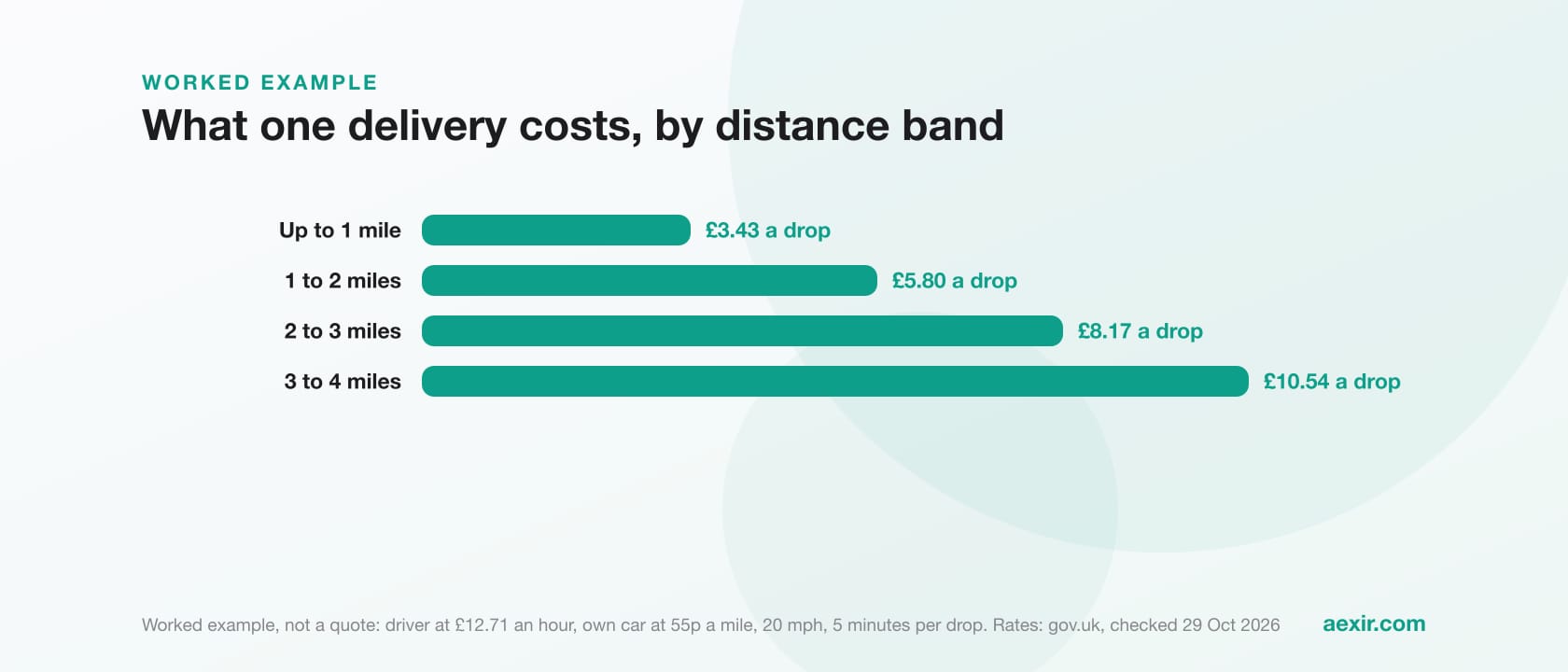
Chart: Aexir, from the figures in this article
To set delivery charges for a takeaway, work out what one delivery costs you at each distance (driver time plus fuel or a mileage allowance), charge by distance band or drawn zone, set a minimum order for each band, and offer free delivery only where the basket can carry the full cost. In our worked example, using 2026 wage and HMRC mileage rates, a drop costs about £3.43 within a mile and £10.54 at four miles. Below: the sums, radius bands against drawn zones, what Uber Eats, Deliveroo and Just Eat publish about their customer delivery fees, and how delivery pricing works in Aexir.
Short answer: price delivery from your own cost per drop, not from what the shop down the road charges. Charge more in outer bands or zones, set higher minimums there, put any free-delivery threshold where the order can carry the whole cost, and check delivery income against delivery cost every month.
Step 1: work out what one delivery costs you
A delivery has three costs: the driver’s time (out, handover and back), the vehicle (fuel, or a mileage allowance if the driver uses their own car or moped) and the waiting, because a driver paid by the hour is paid between runs too. Only the first two change with distance, which is why delivery is priced in bands.
Every input below is published, so you can start from real figures rather than guesses.
| Cost input | Published figure | Source |
|---|---|---|
| Driver wage, aged 21 and over | £12.71 an hour from 1 April 2026 (about 21.2p a minute), rising to £13.21 in April 2027 | gov.uk/national-minimum-wage-rates |
| Mileage allowance, employee’s own car or van | 55p a mile for the first 10,000 business miles from 6 April 2026, then 25p | gov.uk/expenses-and-benefits-business-travel-mileage/rules-for-tax |
| Mileage allowance, own motorcycle or moped | 24p a mile (bicycles 20p) | Same gov.uk page |
| Fuel only, company petrol car | 14p a mile up to 1,400cc, 17p from 1,401cc to 2,000cc, from 1 September 2026 | gov.uk/guidance/advisory-fuel-rates |
| Fuel only, company diesel or electric car | Diesel 15p a mile up to 1,600cc; electric 7p charged at home | gov.uk/guidance/advisory-fuel-rates |
| An on-demand courier instead of a driver | From £5.50 per delivery ex VAT (Stuart, small business tier) | stuart.com/pricing |
All checked 29 October 2026. Mileage allowances are for employees using their own vehicle; advisory fuel rates cover fuel only, for company cars.
The sum: cost per drop = (minutes per drop × wage per minute) + (round-trip miles × cost per mile) + (waiting minutes in the shift × wage per minute ÷ drops in the shift). Employer National Insurance, holiday pay and insurance sit on top.
Worked example: cost per drop by distance band
This is a worked example with assumed figures, not a quote. The driver is paid £12.71 an hour, averages 20 mph, spends 5 minutes parking and handing over each order, and comes straight back. Costs are worked at the outer edge of each band.
| Band (distance from the shop) | Round trip and time | Driver wages | Car at 55p a mile | Cost per drop by car | Cost per drop by moped at 24p a mile |
|---|---|---|---|---|---|
| Up to 1 mile | 2 miles, 11 minutes | £2.33 | £1.10 | £3.43 | £2.81 |
| 1 to 2 miles | 4 miles, 17 minutes | £3.60 | £2.20 | £5.80 | £4.56 |
| 2 to 3 miles | 6 miles, 23 minutes | £4.87 | £3.30 | £8.17 | £6.31 |
| 3 to 4 miles | 8 miles, 29 minutes | £6.14 | £4.40 | £10.54 | £8.06 |
Worked example: £12.71 an hour, HMRC mileage allowance 55p a mile (car) and 24p (moped), 20 mph, 5 minutes per handover, one drop per trip. Before employer costs and waiting time. Rates from gov.uk, checked 29 October 2026.
Waiting time pushes the real figure up. On a four-hour shift with 10 drops averaging 17 minutes, 170 minutes are on the road and 70 are spent waiting, which adds £1.48 to every drop (70 minutes at £12.71 an hour, over 10 drops). Batching pulls it down: two orders in the same direction share most of the return leg.
As a sense check, Stuart’s £5.50 sits between the first and second bands, but it is a starting price and Stuart says peak-hour pricing may apply in some cities. Couriers are covered in full in restaurant delivery without your own drivers.
Step 2: radius pricing or drawn delivery zones
Radius bands charge by distance from the shop: £1.50 within a mile, £2.50 within two, and so on. Drawn zones are shapes on a map, each with its own fee and minimum order. A common route is to start with bands and add zones where the circle is wrong.
| Compared on | Radius bands | Drawn zones |
|---|---|---|
| Decided by | Distance from the shop to the customer’s postcode | Which shape on the map the address falls in |
| Best for | An even street grid, a first setup, prices customers grasp at a glance | Rivers, railways, ring roads, estates that are close but slow to reach, fast roads out of town |
| Watch out for | A mile in a straight line can be much further by road, so some cheap-band drops cost far more | More upkeep; a boundary across a street splits neighbours, so test postcodes near every edge |
| Price it from | Your cost per drop at the outer edge of each band | The slowest drop in each zone, not the nearest |
A practical rule: draw a zone wherever driving time is out of line with distance. If the far side of a river is half a mile away as the crow flies but twelve minutes by road, price it like the 2 to 3 mile band, or leave it to couriers or collection.
Step 3: set minimum orders and free-delivery thresholds
In the worked example below, no fee covers the whole cost of a drop, and it does not have to: part of delivery is the price of winning the order. The minimum order stops a small basket losing money. Decide the most you will spend on delivery out of each order, then work back.
| Band | Cost per drop by car | Example fee | Cost left with you | Example minimum order | Cost left as a share of the minimum |
|---|---|---|---|---|---|
| Up to 1 mile | £3.43 | £1.50 | £1.93 | £12 | 16% |
| 1 to 2 miles | £5.80 | £2.50 | £3.30 | £15 | 22% |
| 2 to 3 miles | £8.17 | £3.50 | £4.67 | £20 | 23% |
| 3 to 4 miles | £10.54 | £4.50 | £6.04 | £25 | 24% |
Worked example, continued from the table above. Fees and minimums are illustrations, not recommendations for your area.
Free delivery is the same sum in reverse. With no fee, the order carries the whole cost per drop, so the lowest safe threshold is the cost per drop divided by the share of the order you will spend on delivery. At 20%, that is £17.15, £29.00, £40.85 and £52.70 for the four bands. Here, free delivery over £30 within two miles holds up; across all four bands it does not.
Show the fee before the customer commits. The CMA’s price transparency guidance (CMA209, 18 November 2025) counts delivery charges as mandatory where the customer cannot collect, with a food delivery app as its example, and expects them in the total once the address makes them calculable. With free delivery over a threshold, the full fee stays in the running total until the basket reaches it, and advertising the threshold without the fee below it may mislead. Minimum orders should be made clear. A summary, not legal advice: read the guidance at gov.uk/government/publications/price-transparency-cma209 (checked 29 October 2026).
How the marketplaces price delivery to their customers
All three marketplaces publish how their customer fees work, and all three link the delivery charge to distance; only Uber Eats gives its delivery fee range in pounds. What the restaurant pays is separate: see Just Eat vs Deliveroo vs Uber Eats fees.
| Marketplace (UK) | Delivery fee | Distance surcharge | Small order fee | Service charge |
|---|---|---|---|---|
| Uber Eats | Varies with location, restaurant and courier availability; £0.29 to £14.99 | Long Range Fee beyond the standard 4 km, £0.99 to £3.99 | £0.99 under a £10 subtotal, where Uber delivers | 12% of subtotal, £0.99 to £3.29; a 12% marketplace fee instead, with no small order fee, where the shop delivers |
| Deliveroo | Varies with distance; partners using their own drivers set their own fee | Extended delivery fee for partners further away, not eligible for free delivery | Charged below the restaurant’s minimum spend | Charged; no figure on the FAQ page |
| Just Eat | Can vary with distance, the store, order value and sometimes time of day | None listed separately | Charged below the restaurant’s minimum order, or as a fixed fee on small baskets at some partners; no threshold given | 99p to £2.99 when a Just Eat courier delivers; from 50p when the restaurant delivers |
As published, checked 29 October 2026: uber.com/gb/en/blog/understanding-fees-and-arrival-time (dated 7 April 2026), deliveroo.co.uk/faq, Just Eat UK help centre articles “Understanding Fees” and “What is the service charge for?”. Uber One and Deliveroo Plus members can get £0 delivery fees on eligible orders, and Just Eat+ members get £0 delivery on orders over £15 at participating partners.
Three lessons carry over. Customers who order on the apps already see delivery priced by distance. A minimum order protects you from small baskets, as the small order fee does on the apps. And on the apps a service charge sits on top of delivery, from 99p on Uber Eats and from 50p on Just Eat when the restaurant delivers; on your own channel the customer sees your delivery fee plus any service fee you choose to add.
A checklist for setting your delivery charges
- Time ten real deliveries to each part of your area and note the miles.
- Work out the cost per drop for each band with your own wage, vehicle and waiting time.
- Draw the area by driving time, cutting out pockets that are close but slow.
- Set a fee and a minimum order per band or zone, highest at the edge.
- Set any free-delivery threshold from the cost per drop, not a round number that sounds generous.
- Show the fee, minimum and threshold before checkout, and keep collection easy to find.
- Every month, compare delivery income with driver and courier costs, and adjust.
Delivery zones and radius pricing in Aexir
Aexir is an online ordering system for independent restaurants and takeaways: their own branded iOS and Android ordering app, ordering website and browser till (POS on the Go), for a flat monthly fee at published prices. Delivery and collection are on every plan, and per-branch delivery zones, service fee and settings are listed on every plan on the pricing page.
- Per branch: delivery on or off, a delivery radius with fees by distance, free delivery over a set spend, and a minimum order for delivery.
- In POS on the Go (included on Web and Pro), delivery zones drawn on a map as shapes or circles, each with its own fee and minimum order. Checkout on the app and website still prices delivery from the distance settings for now, so keep those set up as well.
- A per-branch service fee, if you choose to charge one.
- In the UK, a partner courier booked per delivery from the till, charged per delivery if you use it, or your own driver. Aexir has no delivery fleet.
UK plans are Web at £30 a month ex VAT (ordering website and POS on the Go), Starter at £30 (branded iOS and Android app), Plus at £40 (app and website) and Pro at £50 (app, website and POS on the Go). Card payments are 2.5% + 30p through Stripe, and additional locations are £1 a day each. The till and ordering screens show prices in pounds or euros, and address lookup covers the UK and France. Outside the UK and France, check currency, tax, card payments and delivery for your country with us on the call before you sign. The delivery tools are listed on the takeaway EPOS page.
Set your own delivery fees
An ordering website, a branded iOS and Android app, or both, with delivery fees by distance, minimum orders and free-delivery thresholds per branch, and your own drivers or, in the UK, partner couriers per order. Plans from £30 a month ex VAT at published prices.
View the online ordering systemTalk to a real person about switching
Common questions answered.
There is no standard figure: work out your cost per drop for each distance band and charge part or all of it. In our worked example (£12.71 an hour, 55p a mile), a drop costs about £3.43 within a mile and £10.54 at 3 to 4 miles, before waiting time and employer costs.
Radius bands are quick to set up and easy to understand on an even street grid. Draw zones where driving time is out of line with distance, such as across a river, railway or ring road.
Set it so the delivery cost you absorb stays within a share of the order you accept. In our worked example, a £2.50 fee on a £5.80 drop leaves £3.30 with you, 22% of a £15 minimum.
When the order can carry the whole cost per drop. Divide the cost per drop by the share of the order you will spend on delivery: at 20%, a £5.80 drop needs a £29 order.
All three link the delivery charge to distance and can add a service charge and a small order fee. Uber Eats publishes a delivery fee of £0.29 to £14.99 and a 12% service fee between £0.99 and £3.29; Just Eat’s service charge is 99p to £2.99 on its courier deliveries (checked 29 October 2026).
Yes, in POS on the Go, as shapes or circles, each with its own fee and minimum order. Checkout on the app and website still prices delivery from the per-branch distance settings for now (radius, fees by distance, free delivery over a set spend, minimum order), so keep those set up as well.
Build your own restaurant app.
Aexir launches branded ordering apps for UK restaurants in under 30 days. A flat monthly fee at published prices. From £1/day.