Operations
Takeaway Refund Rules UK: When You Must Refund a Food Order (2026)
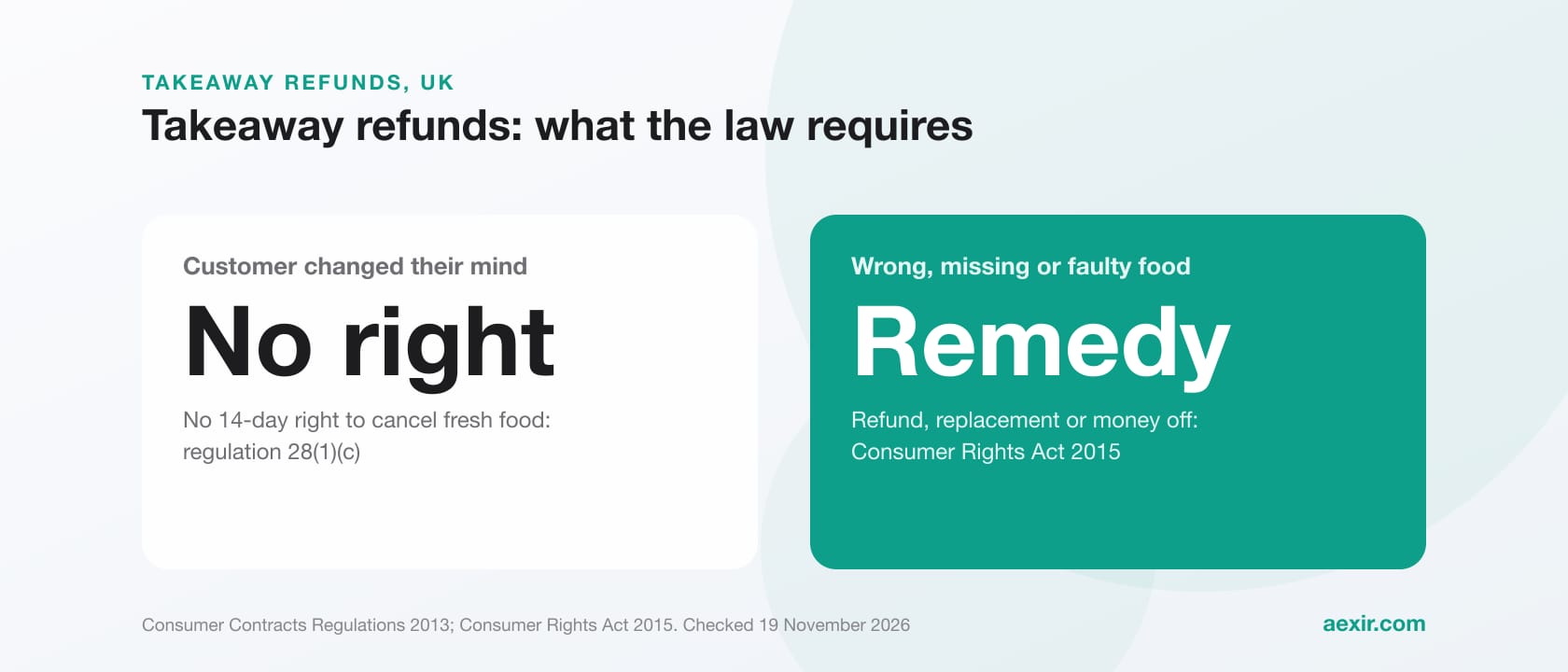
Chart: Aexir, from the figures in this article
A UK takeaway does not have to refund an online or phone order just because the customer changed their mind: the 14-day cancellation right does not cover "goods which are liable to deteriorate or expire rapidly" (Consumer Contracts Regulations 2013, regulation 28(1)(c)). It does have to put things right when food is wrong, missing, not of satisfactory quality or never delivered, under the Consumer Rights Act 2015, and ordering terms cannot remove those rights. Legislation read on legislation.gov.uk on 19 November 2026.
Short answer: a change of mind on freshly prepared food carries no 14-day right to cancel, and you must say so before the order. Wrong, missing, unsafe or undelivered food is different: the Consumer Rights Act 2015 gives the customer a refund, a replacement or money off, whatever your terms say.
Do I have to refund a takeaway order if the customer changes their mind?
Orders taken on your website, app or phone are distance contracts under the Consumer Contracts (Information, Cancellation and Additional Charges) Regulations 2013 (regulation 5). Most distance sales can be cancelled within 14 days "without giving any reason" (regulations 29 and 30).
Fresh food is an exception. Regulation 28(1)(c) removes that right for "the supply of goods which are liable to deteriorate or expire rapidly". Business Companion, the government-backed Trading Standards guidance, gives "a delivery of fresh flowers or meat" as its example (Consumer contracts: distance sales, updated April 2025), and gov.uk lists "perishable items, for example frozen food or flowers" among items where "you only have to offer a refund if they are faulty".
One caution: the wording describes the goods. A cooked meal fits; a sealed can or bottle does not obviously fit.
Regulation 6(1)(f) also excludes contracts "for the supply of foodstuffs, beverages or other goods intended for current consumption in the household and which are supplied by a trader on frequent and regular rounds to the consumer's home, residence or workplace". Business Companion's example is "the delivery of milk". A one-off meal delivered on request does not match that, so do not rely on it.
A customer can still withdraw an order "if it has not been accepted by the trader" (Business Companion), so say in your terms when you accept. After that, a change-of-mind refund is your choice.
Has the Digital Markets, Competition and Consumers Act 2024 changed this?
Not for one-off food orders. On 19 November 2026, legislation.gov.uk showed regulation 28 and the Consumer Rights Act sections quoted here as up to date, noting "There are changes that may be brought into force at a future date." Those changes (sections 278 and 279 of the 2024 Act) concern subscription contracts and are still marked prospective. Draft regulations for the subscription rules state: "These Regulations come into force on 1st January 2027."
What the customer is still entitled to under the Consumer Rights Act 2015
That exception only covers a change of mind. gov.uk: "You must offer a full refund if an item is faulty, not as described or does not do what it’s supposed to." The Act writes these terms into a food order:
| Right | Section | What the Act says |
|---|---|---|
| Satisfactory quality | 9 | "the quality of the goods is satisfactory"; quality "includes their state and condition", and safety is part of it. |
| Fit for a stated purpose | 10 | If the customer makes a purpose known, the goods must be "reasonably fit for that purpose". |
| As described | 11 | "the goods will match the description"; information on a dish's main characteristics "is to be treated as included as a term of the contract". |
| Delivery | 28 | "the trader must deliver the goods to the consumer": with no agreed time, "without undue delay" and "not more than 30 days after the day on which the contract is entered into". |
| Risk on the way | 29 | "The goods remain at the trader's risk until they come into the physical possession of" the consumer or a person they identify. |
The Act "extends to England and Wales, Scotland and Northern Ireland" (section 99).
Remedies when the food is not right
If food breaches section 9, 10 or 11, the customer can reject it for a refund or have it replaced, with a price reduction where a replacement is impossible, fails or takes too long (sections 19 to 24). The right to reject normally lasts 30 days, but section 22(4) shortens it for food: "If any of the goods are of a kind that can reasonably be expected to perish after a shorter period, the time limit for exercising the short-term right to reject in relation to those goods is the end of that shorter period". The Act gives no number of hours.
A price reduction "may, where appropriate, be the full amount of the price" (section 24). A refund "must be given without undue delay, and in any event within 14 days beginning with the day on which the trader agrees that the consumer is entitled to a refund", by "the same means of payment as the consumer used" unless they expressly agree otherwise (section 20).
Example: a £30.00 order arrives with one £8.00 dish missing. Section 25 covers short delivery: a customer who keeps the rest "must pay for them at the contract rate", so £8.00 goes back to the card they paid with.
Late, cold or never arrived
If you miss an agreed delivery time, the customer can end the contract where that time "is essential taking into account all the relevant circumstances at the time the contract was entered into" (section 28(6)). Otherwise they can set a further period "that is appropriate in the circumstances" and end the contract if that is missed too. Then "the trader must without undue delay reimburse all payments made under the contract" (section 28(7) to (9)).
The Act does not say whether a checkout estimate makes time essential. But food lost or spoiled on the way is at your risk, courier or not: "if your carrier fails to deliver the goods, or delivers them to the wrong address, this is your responsibility and not the consumer's" (Business Companion).
Where delivery is a service you provide, the services chapter can apply too: "reasonable care and skill" (section 49), performance "within a reasonable time" where none is fixed (section 52), and remedies that include "the right to require the trader to reduce the price to the consumer by an appropriate amount" (section 56).
Common situations: what the law points to
| Situation | What the law points to | Where |
|---|---|---|
| Wrong item | Must match its description: refund, replacement or money off. | Sections 11 and 19 to 24 |
| Missing item | Short delivery: the customer pays only for what arrived. | Section 25 |
| Arrived cold or in poor condition | Quality includes state and condition, and the food is at your risk until handed over. | Sections 9, 29 and 19 to 24 |
| Very late | Reimburse if the time was essential, or once a further period the customer sets is missed. Whether a checkout estimate is essential is not spelled out. | Sections 28, 52 and 56 |
| Changed their mind | No 14-day right for food liable to deteriorate rapidly. Once you accept the order, it is your policy. | 2013 Regulations, regulation 28(1)(c) |
| Not at the address | No clean answer: see the terms section below. | Sections 28, 29, 31 and 62; Sale of Goods Act 1979, section 37 |
| Allergy information was wrong | Dish information is a contract term and safety is part of quality. Also a food law matter. | Sections 9, 10 and 11 |
| Never arrived | Your responsibility, even if a courier loses it: deliver in a period the customer sets, or reimburse. | Sections 28 and 29 |
Sections are from the Consumer Rights Act 2015 unless stated.
For the food law side, see our guide to allergen information for online orders.
What must customers be told before they order?
Regulation 13 applies "Before the consumer is bound by a distance contract": you must give the Schedule 2 information "in a clear and comprehensible manner". For a takeaway that means:
- What each dish is and who you are, with "the geographical address at which the trader is established" (paragraphs (a) to (c)).
- The total price "inclusive of taxes" and "all additional delivery charges and any other costs" (paragraphs (f) and (g)); see our guide to setting delivery charges and zones.
- "the arrangements for payment, delivery, performance, and the time by which the trader undertakes to deliver the goods" (paragraph (j)).
- Where there is no right to cancel, "the information that the consumer will not benefit from a right to cancel" (paragraph (o)), and "a reminder that the trader is under a legal duty to supply goods that are in conformity with the contract" (paragraph (p)).
You must also confirm the contract "on a durable medium", such as an email or printed receipt, "not later than the time of delivery of any goods supplied under the contract" (regulation 16). In a dispute, "the burden is placed upon you to prove that you have done so" (Business Companion).
Can your terms say no refund if the customer is not in?
Take this example wording: "If you are not at the address when the driver arrives and cannot be reached, the order may be treated as delivered and is not refundable."
Terms must be fair and clear. "A term is unfair if, contrary to the requirement of good faith, it causes a significant imbalance in the parties' rights and obligations under the contract to the detriment of the consumer" (section 62(4)), and an unfair term "is not binding on the consumer". Section 68 adds: "A trader must ensure that a written term of a consumer contract, or a consumer notice in writing, is transparent", meaning "expressed in plain and intelligible language" and legible (section 64).
Some rights cannot be removed. Section 31: "A term of a contract to supply goods is not binding on the consumer to the extent that it would exclude or restrict the trader's liability arising under any of these provisions", including sections 9 to 11, "section 28 (delivery of goods)" and "section 29 (passing of risk)". Section 57 does the same for services: a term is not binding "to the extent that it would exclude the trader's liability arising under section 49".
So the legislation does not settle a not-at-home term. You must deliver, and the food stays at your risk until the customer has it. But under section 37 of the Sale of Goods Act 1979, a buyer who does not take delivery within a reasonable time of being asked "is liable to the seller for any loss occasioned by his neglect or refusal to take delivery". Against that, the Consumer Rights Act's list of terms that may be unfair includes one "requiring a consumer who fails to fulfil his obligations under the contract to pay a disproportionately high sum in compensation" (Schedule 2, paragraph 6).
A clear term, shown before the order and backed by a record that the driver arrived, waited and tried to call, helps, but does not decide the outcome: "It’s up to the courts to decide if a term in your contract or wording in your notices is unfair" (gov.uk). Trading Standards or a solicitor can check your wording.
Card disputes and delivery app orders
A customer who paid by card may also go to their bank. The Financial Ombudsman Service says customers "usually have around 120 days to raise a chargeback about goods or services". Keep the order record, the delivery time and any driver notes.
This guide covers orders on your own website, app and phone. For an order placed through a delivery app, the app's own terms decide who handles a refund. If you are comparing channels, try our delivery app savings calculator.
What to put in your ordering terms and keep on record
- Terms: when an order is accepted, and that fresh food has no 14-day right to cancel.
- Terms: that wrong, missing or faulty items will be put right, and how to report them. You can ask for a photo, but a remedy cannot depend on "a restrictive or onerous condition" (section 31(2)).
- Terms: what the driver does if nobody answers: how long they wait and how they try to reach the customer.
- Terms: no blanket no-refunds line. "It is illegal to try to exclude a consumer's statutory rights, so a 'no refunds' notice is not permitted" (Business Companion, Selling and supplying goods, updated June 2026).
- Records: the order, time, price and terms shown; the confirmation sent; kitchen, dispatch and delivery times; driver notes; complaints, photos and refunds. These hold personal data: see our guide to customer data and GDPR for takeaways.
This guide is general information, not legal advice. The legislation applies across the UK; Business Companion's guidance covers England, Scotland and Wales (its goods guide England and Wales only), and we did not check Northern Ireland guidance. For your own terms or a live dispute, ask your local Trading Standards service or a solicitor.
Where Aexir fits
Aexir provides an ordering website, a branded iOS and Android app, QR table ordering, loyalty, push notifications and a POS. Plans are £30, £40 and £50 a month ex VAT at published prices; see the pricing page.
Sources
| Source | What it covers | Address |
|---|---|---|
| Consumer Contracts (Information, Cancellation and Additional Charges) Regulations 2013 | Cancellation and pre-contract information | legislation.gov.uk/uksi/2013/3134 |
| Consumer Rights Act 2015 | Goods, delivery, services, unfair terms | legislation.gov.uk/ukpga/2015/15 |
| Sale of Goods Act 1979, section 37 | Not taking delivery | legislation.gov.uk/ukpga/1979/54/section/37 |
| Digital Markets, Competition and Consumers Act 2024, section 279 | Subscription changes, not in force | legislation.gov.uk/ukpga/2024/13/section/279 |
| Draft Consumer Subscription Contracts (Cancellation and Information) Regulations 2026 | Planned start date | legislation.gov.uk/ukdsi/2026/9780348287912 |
| gov.uk: Accepting returns and giving refunds | When a refund is due | gov.uk/accepting-returns-and-giving-refunds |
| gov.uk: Unfair consumer contracts | Unfair terms | gov.uk/unfair-terms-in-sales-contracts/unfair-consumer-contracts |
| Business Companion: Consumer contracts: distance sales (updated April 2025) | Trading Standards guidance | businesscompanion.info/en/quick-guides/distance-sales/consumer-contracts-distance-sales |
| Business Companion: Selling and supplying goods (updated June 2026) | Trading Standards guidance | businesscompanion.info/en/quick-guides/goods/selling-and-supplying-goods |
| Financial Ombudsman Service: section 75 and chargeback | Card chargebacks | financial-ombudsman.org.uk/consumers/complaints-can-help/credit-borrowing-money/goods-services-bought-credit |
All pages checked 19 November 2026.
Take orders on your own channel
An ordering website, a branded iOS and Android app, QR table ordering, loyalty, push notifications and a POS. Plans are £30, £40 and £50 a month ex VAT at published prices.
See the takeaway ordering systemTalk to a real person about switching
Common questions answered.
Not for freshly prepared food. The 14-day right to cancel online and phone orders does not apply to "goods which are liable to deteriorate or expire rapidly" (Consumer Contracts Regulations 2013, regulation 28(1)(c), checked 19 November 2026). You must tell customers this before they order.
Yes, the customer is entitled to a remedy. Food must match its description (Consumer Rights Act 2015, section 11), and where less arrives than was ordered the customer pays only "at the contract rate" for what came (section 25). A refund is due within 14 days of agreeing it, by the same payment method (section 20).
Food must be of satisfactory quality and stays at your risk until it is in the customer's physical possession (Consumer Rights Act 2015, sections 9 and 29). For lateness, section 28 lets the customer end the contract and be reimbursed if the agreed time was essential, or once a further period they set is missed. The Act does not say whether a checkout estimate counts as essential.
The legislation gives no clean answer. You must deliver and carry the risk until the food is handed over (Consumer Rights Act 2015, sections 28 and 29), but a buyer who does not take delivery can be liable for the seller's loss (Sale of Goods Act 1979, section 37). A clear, fair term shown before the order helps; ask Trading Standards or a solicitor to check it.
Not as a blanket rule. Section 31 of the Consumer Rights Act 2015 says a term is not binding to the extent that it would exclude or restrict your liability for quality, description, delivery or risk, and Business Companion says a no-refunds notice "is not permitted". You can say that fresh food cannot be cancelled for a change of mind.
The Consumer Rights Act 2015, section 20, says "without undue delay, and in any event within 14 days beginning with the day on which the trader agrees that the consumer is entitled to a refund". It goes back by the same means of payment unless the customer expressly agrees otherwise, with no fee.
Not for one-off food orders as at 19 November 2026. The pending amendments shown on legislation.gov.uk (sections 278 and 279 of the 2024 Act) concern subscription contracts and are marked prospective. The draft regulations for those say they "come into force on 1st January 2027".

Build your own restaurant app.
Aexir launches branded ordering apps for restaurants in under 30 days. Sets up restaurants in the UK, France and worldwide; prices in £ or € only. A flat monthly fee at published prices. From £1/day.
Prefer to do it yourself? Choose your plan, design your app and website, then sign and pay in one step. Build it yourself today