Strategy
What Is a White-Label Ordering App? A Plain-English Guide for Restaurants
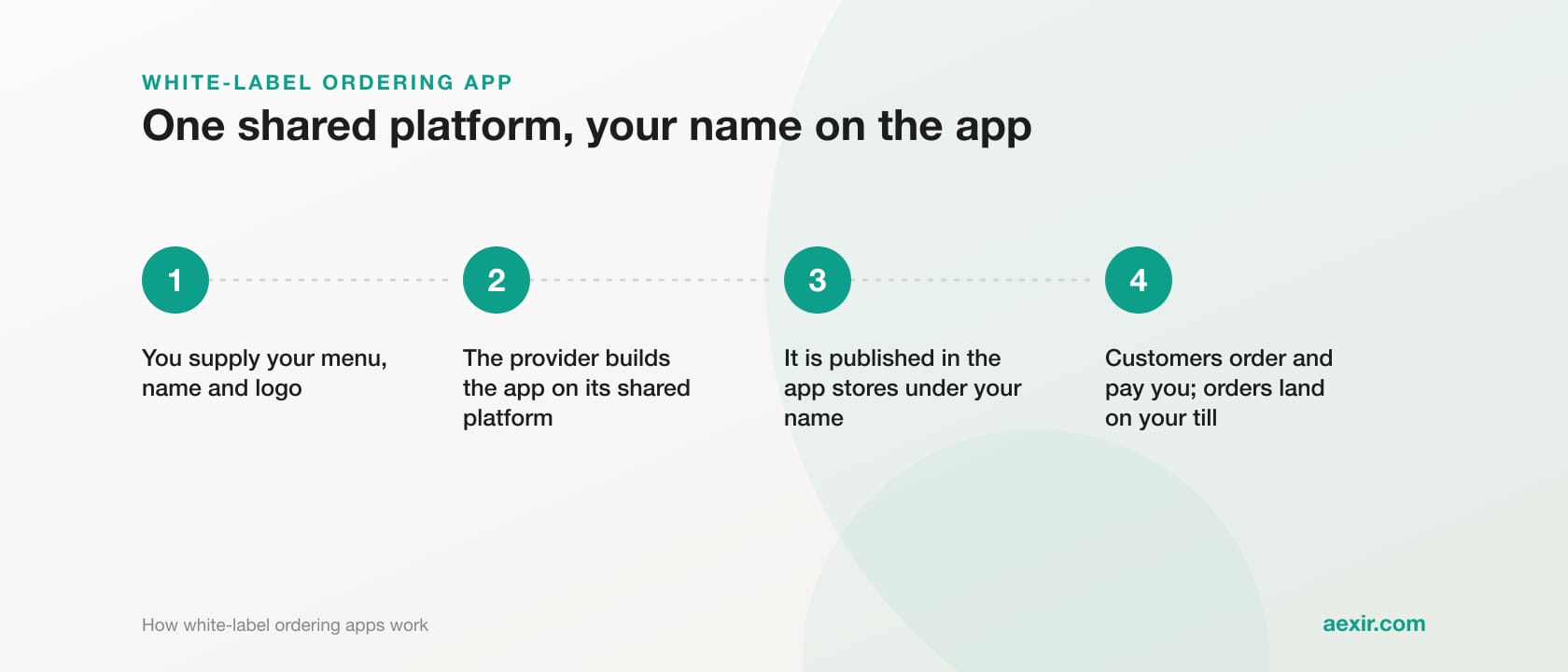
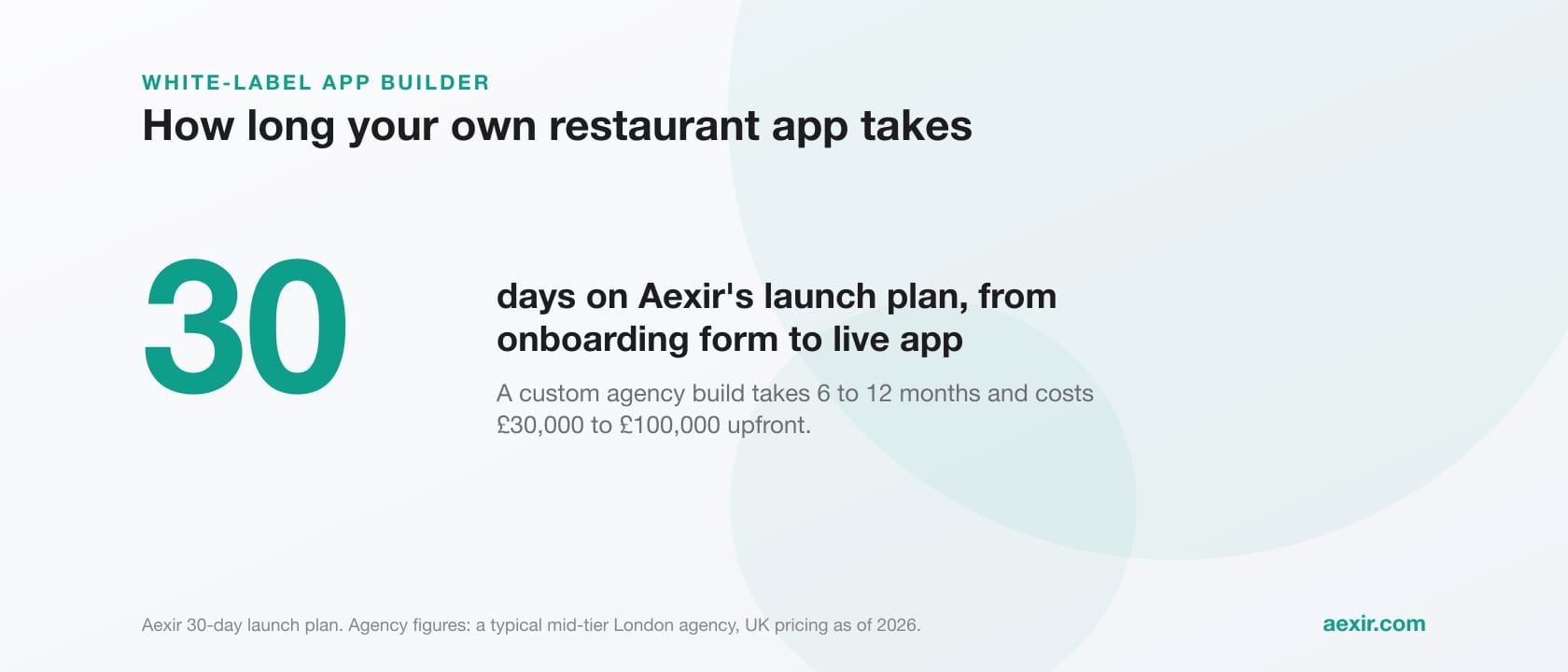
Chart: Aexir, from the figures in this article
A white-label ordering app is a restaurant’s own branded iOS and Android app, built on a provider’s ready-made ordering platform instead of being coded from scratch. Customers find it under the restaurant’s name, order and pay the restaurant rather than a marketplace, and orders go straight to the restaurant. The provider runs and updates the software for a recurring fee. Below: how it differs from a marketplace and from a custom build, who owns the listing, the customers and the data, and published UK prices from the Aexir price index, checked 28 October 2026. Aexir sells one of these apps, so its prices sit in the same table as everyone else’s.
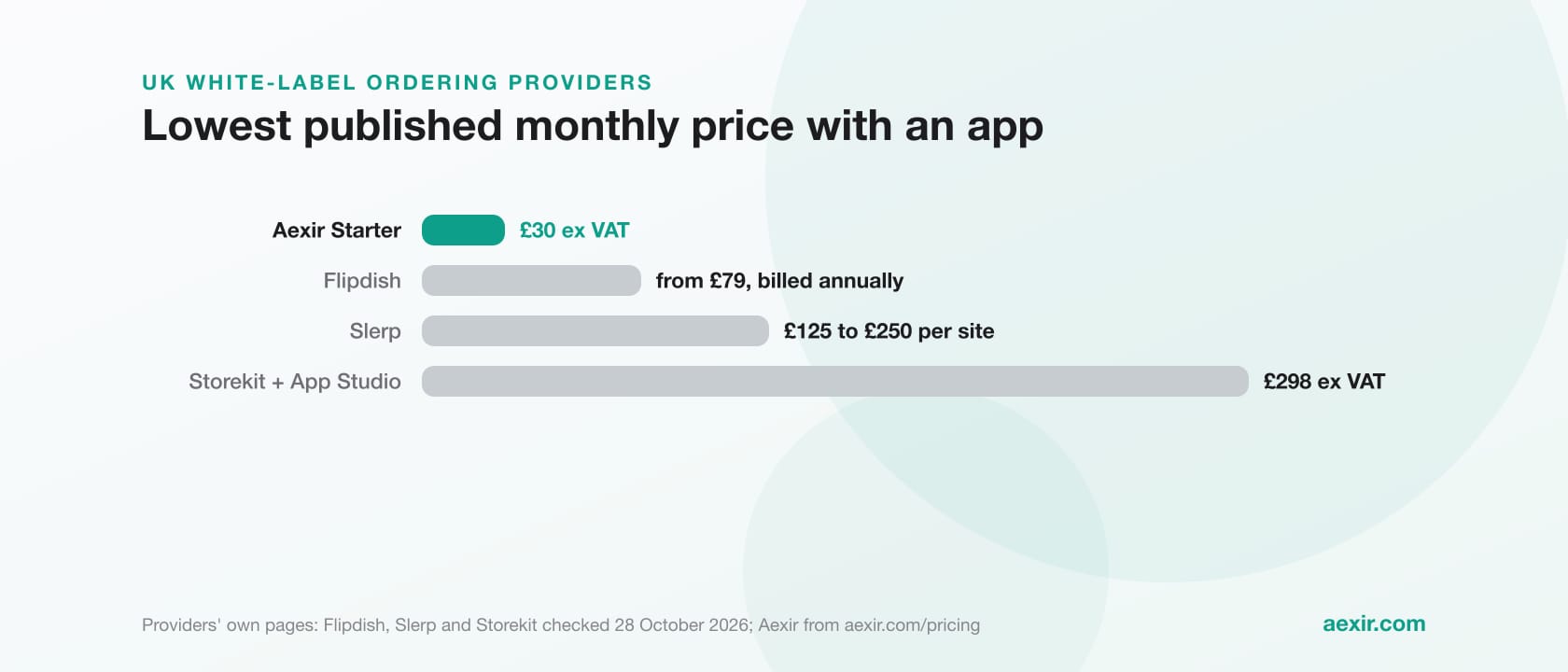
Short answer. White-label: your name and menu on a provider’s platform. Marketplace: your restaurant listed inside someone else’s app. Custom-built: your own code, and your own bill for every update. Published UK prices for the cheapest plan with a branded iOS and Android app run from £30 a month (Aexir Starter) to £298 (Storekit Pro plus App Studio), both ex VAT, before card fees and app store accounts. Rows in the price index.
What does white-label mean?
The term comes from manufacturing: one company makes a product and another sells it under its own brand, as if the label had been left blank for them.
In restaurant ordering, the provider builds one ordering platform (menu engine, checkout, payments, order management) and produces a separate app from it for each restaurant. Your customers see your name on the icon, your colours, your menu and your prices. Underneath runs the same software as every other restaurant on the platform, which is why it sells for a monthly fee rather than a development budget.
What one usually includes, varying by provider and plan:
- A native iOS and Android app published in the App Store and Google Play under the restaurant’s name.
- Your menu, delivery and collection, and checkout by card, Apple Pay or Google Pay.
- A screen, tablet, printer or till where the orders arrive.
- Customer accounts and order history, so a repeat order takes seconds.
- Push notifications, offers or loyalty, often on the higher plans.
- Often an ordering website on the same menu, sometimes at extra cost.
White-label app vs marketplace vs custom-built app
Against a marketplace (Just Eat, Uber Eats, Deliveroo)
On a marketplace your restaurant is one listing in someone else’s app, a scroll from your competitors. It brings customers you did not have to find, and charges commission on those orders; rates are in our Just Eat, Deliveroo and Uber Eats fees comparison. The customer’s account, and the habit of opening that app, belong to the marketplace.
A white-label app turns that round. No rival’s menu is in it and the customer account sits in your app, but nobody sends you new customers: you bring them, from the counter, the bag and your Google listing. Many restaurants run both, the marketplace to be found and their own app for the people who come back.
Against a custom-built app
A custom-built app is written for you alone by an agency or a developer. You get the features you ask for and, if the contract says so, own the code. You also pay for the build and every change after it: Apple and Google release new versions of iOS and Android every year, and payments, hosting and the order screen all need arranging and maintaining.
A white-label app spreads that work across every restaurant on the platform. The trade is control: you get the provider’s features and roadmap, not a blank sheet. App builders that hand you a template to fill in sit in between; our restaurant app builder guide covers them.
Who owns the app listing, the customers and the data?
“Under your name” can mean different things. Separate three questions before you sign.
The app store listing
Every App Store listing names a seller. Apple says that for an organisation account “the legal entity name will be listed as the seller on the App Store”, and an organisation needs a D-U-N-S Number to enrol (Apple Developer, Account Help: Enrollment, checked 29 October 2026). So an app published on the provider’s developer account can carry your name and icon while the provider’s company appears as the seller; on your own Apple and Google accounts, your company does. Providers offer one or the other, or both.
The account matters most when you leave. Both stores let an app move to another developer account: Apple says a transferred app keeps its reviews and ratings and its users continue to receive updates (App Store Connect Help, “Overview of app transfer”, checked 29 October 2026), and Google’s Play Console Help explains how to transfer apps to a different developer account (both checked 29 October 2026). A transfer moves the listing, not the provider’s software, so a new provider would still have to publish a new version of the app.
The customers
In a white-label app the customer signs up in your app, not a marketplace’s. Whether you can download that list yourself, whenever you like, with order history and marketing consent, is a product and contract question. Ask to see the export, not just to be told it exists.
The data
UK data protection law splits the roles in two. The ICO describes a controller as the body which “determines the purposes and means of the processing of personal data”, and a processor as one that processes personal data “on behalf of the controller” (ICO, “What are ‘controllers’ and ‘processors’?”, checked 29 October 2026). Ask which role the contract gives each side. A processor handles your customers’ details on your behalf; a provider whose terms let it use them for its own purposes is deciding those purposes itself.
- Whose Apple and Google developer accounts will the app be published on?
- If I leave, will you transfer the listing to my own accounts, and at what cost?
- Can I export my customer list and order history myself, at any time?
- Does the contract make the restaurant the controller and you the processor?
- Who owns the domain the ordering website runs on?
Those five come from a longer list: see 25 questions to ask an online ordering provider before you sign.
What does a white-label ordering app cost in the UK?
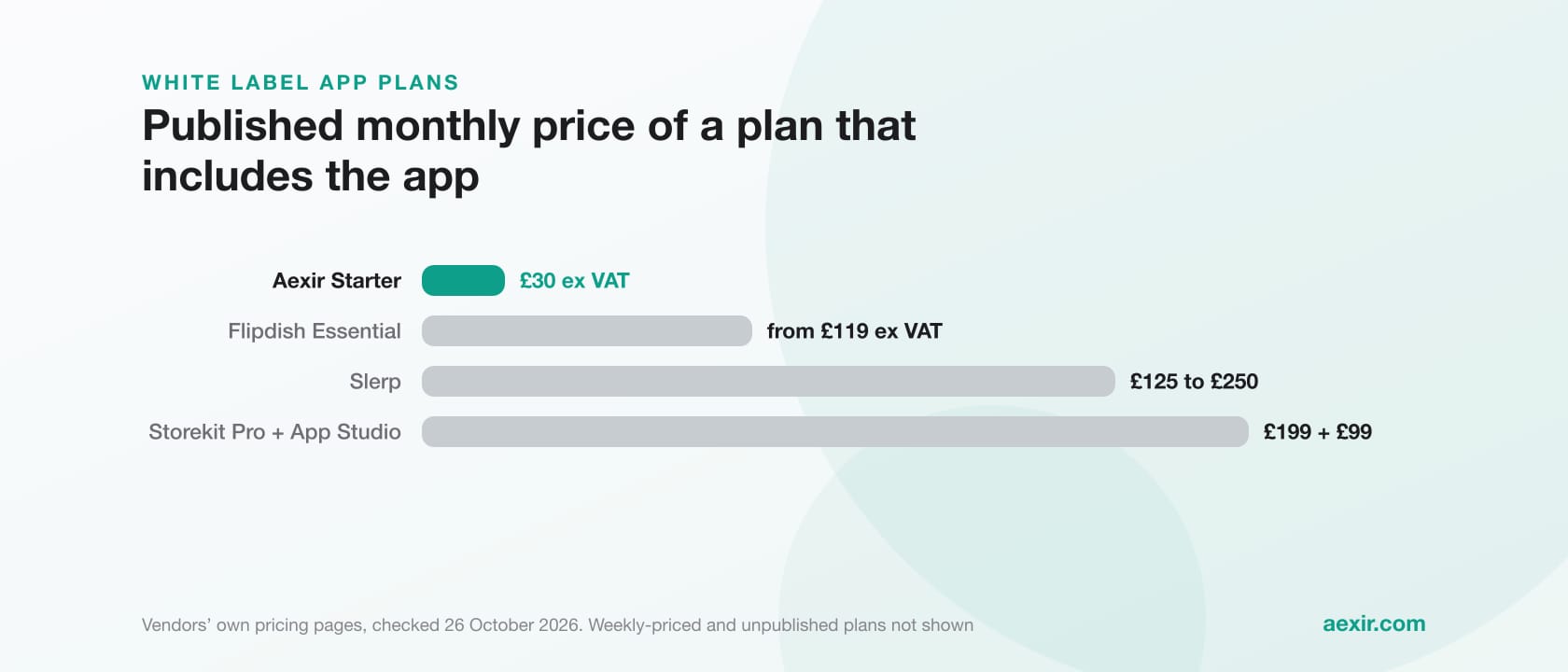
The table shows each UK provider’s cheapest published plan that includes a branded iOS and Android app, from the app plan columns of our price index (also a [CSV file](/ordering-system-prices.csv)). Each row is read from the vendor’s own pages, and an app counts only when those pages say iOS and Android, or App Store and Google Play. Weekly prices stay weekly.
| Provider | Cheapest plan with the app | Published price | What to note |
|---|---|---|---|
| Aexir | Starter | £30 a month, ex VAT | Website added on Plus (£40); app store developer account £30 a year through Aexir, or about £130 a year on your own Apple and Google accounts |
| UpMenu | Mobile App module | £49 a month per location, ex VAT | Web ordering is a separate module |
| Flipdish | Website & Mobile App | From £79 a month per site billed annually (£99 billed monthly) | A “from” price; VAT treatment stated only on its POS bundle |
| Tekeats | Growth | £89 a month per site, ex VAT | £149 one-off to publish the app; plus 2.5% of card orders, separate from card processing |
| BringFood | E-POS + Mobile Apps | £98 a month (E-POS £58 plus Mobile Apps £40) | Website priced separately; the vendor is not VAT registered, so no VAT is added |
| Storekit | Pro + App Studio | £298 a month per location (Pro £199 plus App Studio £99), ex VAT | Setup on Pro from £199 per location; a per-order rate applies, amount not published |
| Grub Direct | Online Ordering | £7.50 a week | Priced weekly; VAT treatment not stated |
| eTakeawayMax | Gold | £14.50 a week | Priced weekly; VAT treatment not stated; the restaurant holds its own App Store accounts (Apple £79 a year, per the vendor) |
Source: Aexir ordering system price index, app_plan_monthly_gbp and app_plan_weekly_gbp columns, each figure read from the vendor’s own pricing pages. Checked 28 October 2026.
Ten more providers in the index sell a branded app but publish no price in pounds for a plan that includes it:
- Not published: Foodhub for Business, GloriaFood (app sold as an add-on), Hungrrr, OrderYOYO, Posso (app offered with no separate price), Sunday (white-labelled guest app on custom pricing) and Vita Mojo.
- A range, not an app plan: Slerp publishes £125 to £250 a site a month “depending on whether a branded native app is included”.
- US dollars only: Menuthere and Ressto.
- Foodhub, GloriaFood, OrderYOYO, Sunday and Vita Mojo were last checked on 26 October 2026.
The monthly fee is rarely the whole bill. Add card processing, per-order charges, setup and app store accounts, and compare the first year, not the first month; see our first-year cost guide. Aexir’s UK plans, a month ex VAT: Web £30 (website and POS on the Go, no app), Starter £30 (app), Plus £40 (app and website), Pro £50 (app, website and POS on the Go), with card payments at 2.5% + 30p. Details are on the pricing page.
Pros and cons of a white-label ordering app
Pros
- Your name on the customer’s home screen, so the next order starts with your app, not a list of rivals.
- A mostly fixed cost instead of a marketplace’s commission on every order, though card processing and some providers’ per-order fees still apply.
- Quicker and cheaper to launch than a custom build, because the platform already exists.
- Customer accounts, push notifications and loyalty let you bring people back without paying a marketplace for each return visit.
Cons
- It does not find customers for you. An app is mostly installed by people who already know your name.
- You depend on the provider: if the listing sits on its account and the contract says nothing about transfer, the app may not leave with you.
- Customers have to download something, a bigger ask for a first order than tapping a website link.
- Fees stack up: subscription, card processing, store accounts and sometimes setup or per-order charges.
How to choose a white-label ordering app
- Decide what you need: an app alone, app and website, or app, website and till. Our best online ordering system in the UK guide compares the options.
- Compare the plan that includes the app, not the headline “from” price, and check monthly or weekly, with or without VAT.
- Add up the first year: fees, setup, store accounts and card processing on your own order volume.
- Get the five ownership answers above in writing.
- Read the minimum term and notice period before you sign, not after.
- Order through an app the provider runs for another restaurant, and see how the order reaches the kitchen.
See what an Aexir ordering app includes
Aexir is an online ordering system for independent restaurants and takeaways: their own branded iOS and Android ordering app, ordering website and browser till (POS on the Go), for a flat monthly fee at published prices. App plans start at £30 a month ex VAT.
See the ordering appProvider by provider: white-label restaurant app prices compared and white-label app providers for UK restaurants.
Common questions answered.
The app is built on a provider’s ready-made ordering platform but published under the restaurant’s own name, logo and colours. The provider runs and updates the software underneath for a recurring fee.
No. On a marketplace you are one listing in someone else’s app, beside competitors, paying commission on its orders. A white-label app contains only your restaurant and customers pay you, but it does not bring you new customers.
You own the brand and, depending on the contract, the customer list; the software belongs to the provider. The app store listing belongs to whoever’s developer account it is published on, and Apple shows that account’s legal entity as the seller. Ask which account is used and whether the listing transfers to you if you leave.
In the Aexir price index, checked 28 October 2026, the cheapest published plan with a branded iOS and Android app costs from £30 a month (Aexir Starter) to £298 (Storekit Pro plus App Studio), both ex VAT; Grub Direct (£7.50) and eTakeawayMax (£14.50) price by the week. Card fees, setup and app store accounts come on top.
A custom-built app is written just for you, so you control the features and can own the code, but you pay for the build and every update after it. A white-label app shares one platform across many restaurants, so it costs less to launch and the provider maintains it, in exchange for less control.
The listing can: Apple and Google both let an app transfer to another developer account, and Apple says it keeps its reviews and ratings. The software belongs to the old provider, so the new one has to publish a new version. Agree transfer terms before you sign.
Keep reading
White Label Restaurant App UK: Prices Compared (2026)
White-Label Ordering App Providers for UK Restaurants, Compared
Restaurant App Builder UK: Your Own App in 2026
25 Questions to Ask an Online Ordering Provider Before You Sign (UK Checklist)
Build your own restaurant app.
Aexir launches branded ordering apps for UK restaurants in under 30 days. A flat monthly fee at published prices. From £1/day.