Marketing
Push Notifications for Takeaways and Restaurants: What to Send, When and How Often (UK)
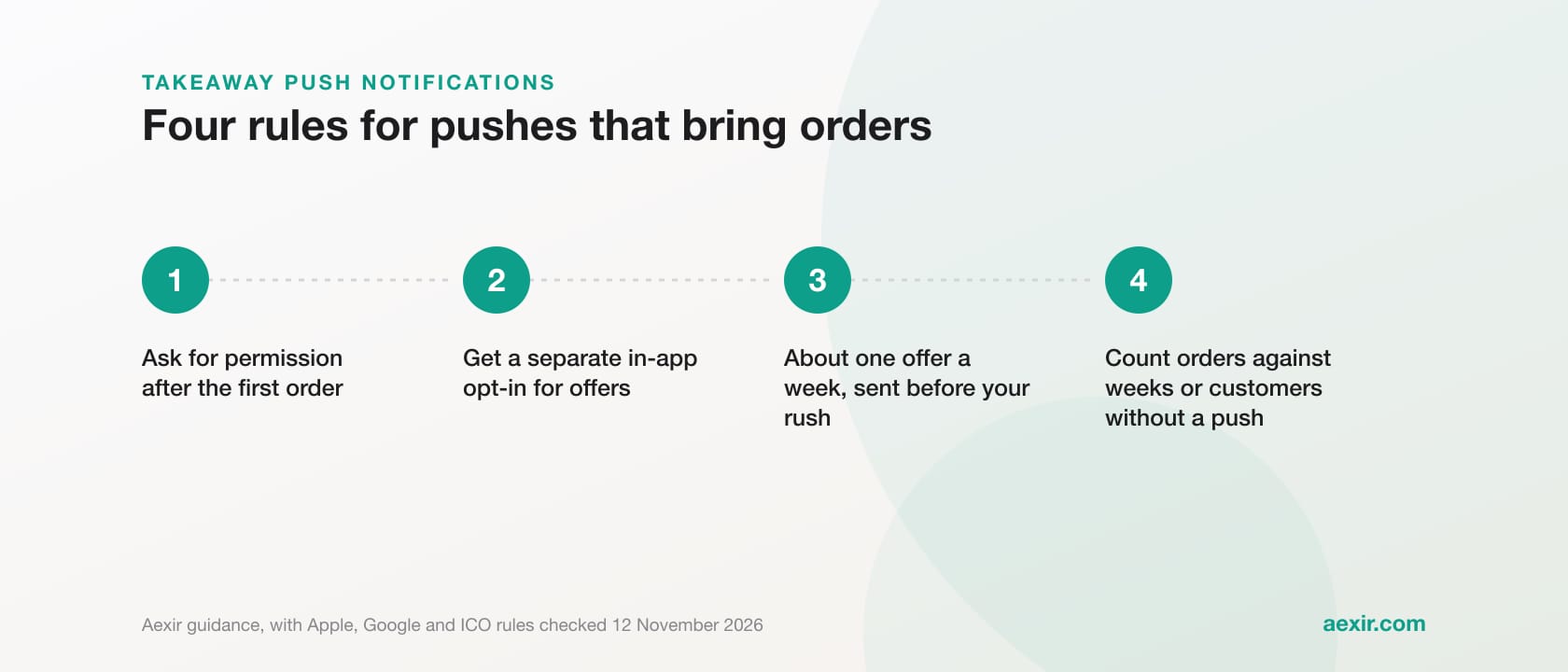
Chart: Aexir, from the figures in this article
Push notifications from a takeaway app bring orders when each one gives a regular a reason to order that day: a quiet-night deal, a dish back on the menu, a reward within reach. Ask for permission after the first order, get a separate in-app opt-in before sending offers (Apple requires one), send about one offer a week shortly before your customers decide, and count orders, not opens. Apple, Google and ICO guidance was checked on 12 November 2026; the example messages are our own, not from real restaurants.
Short answer: send order updates whenever an order changes, and offers (opt-in only) about once a week, 30 to 90 minutes before your usual rush. Never resend an offer that did not land; judge each push by the extra orders it brought.
Order updates and offers are different messages
Every push notification from a takeaway app is one of two things: an order update about an order the customer placed, or an offer or announcement that tries to win the next one. The rules differ.
The ICO says messages sent purely for administrative or customer service purposes are not direct marketing, but adding marketing material makes them direct marketing. “Your order is out for delivery” is a service message; add “10% off next time” and it becomes marketing.
| Compared on | Order updates | Offers and announcements |
|---|---|---|
| Examples | Accepted, out for delivery, ready to collect, running late | Quiet-night deal, new dish, loyalty reward, holiday opening hours |
| Permission | The phone’s notification permission | The phone’s permission plus an explicit opt-in shown in your app, and an in-app opt-out (Apple guideline 4.5.4) |
| Apple urgency level | Time Sensitive suits news about something happening now or within the hour | Never Time Sensitive: Apple says marketing must never break through a Focus or scheduled delivery |
From ICO and Apple guidance, checked 12 November 2026. The urgency level is set by whoever builds your app.
Ask for permission after the first order
On Android 13 and later, Google says a newly installed app’s notifications are off by default until the customer grants permission. Google advises letting people get to know an app before asking, and lists submitting a food delivery order among the good moments to ask.
Apple says the same: ask in a context that shows why, not automatically on first launch. The system prompt appears only the first time an app asks, so a customer who taps Don’t Allow on first open must change it in their phone’s settings.
So let the customer order first, explain the benefit in one line, then show the prompt. Example wording, written for this article: “Want to know when your food leaves the shop? Turn on notifications and we will tell you.”
Ask separately before you send offers
Apple’s guideline 4.5.4 says push notifications should not be used for promotions or direct marketing unless customers have explicitly opted in through consent language shown in your app, with an in-app way to opt out; its design guidelines add a settings screen where people can change that choice. By our reading, the phone’s “Allow notifications” prompt alone is not that opt-in.
Guideline 5.1.2(i) says an app may not require people to turn on push notifications to use it or to receive compensation such as gift cards and codes, so never tie loyalty stamps or a discount to switching notifications on. Guideline 4.5.3 bans using push notifications to spam customers.
UK law is less specific. For emails and texts, the ICO’s Guide to PECR requires specific consent, apart from the soft opt-in for existing customers. Its electronic mail list includes in-app messages, but we found no current ICO page that names push notifications, so we suggest treating promotional pushes like marketing texts. The GDPR guide for takeaways covers consent in full. General information, not legal advice.
What to send: six pushes that earn their place
A push earns its place when a regular is glad to have seen it. The examples below were written for this article, not taken from any restaurant; prices and codes are placeholders.
| Push | When it works | Example message |
|---|---|---|
| Quiet-night deal | Your slowest evening, before dinner is decided | “Tuesday deal: any large pizza £10 until 9pm.” |
| New or returning dish | The day it goes on the menu | “Lamb karahi is back from tonight. Same recipe, same chef.” |
| Reward within reach | One stamp or a few points from a reward | “One more order and your next kebab is on us.” |
| Weather or big night | A wet evening, a big match on TV, the first cold night | “Wet one out there. We are delivering until 11pm.” |
| Win-back | Lapsed customers, if your system can pick them out | “It has been a while. 15% off your next order this week with code BACK15.” |
| Busy-date heads-up | Before Christmas Eve, New Year’s Eve or a bank holiday | “Open New Year’s Eve from 4pm. Order early, it gets busy after 7.” |
Example messages written for this article.
Each one has a reason to act today, one specific detail and nothing to work out. Apple asks for concise, informative notifications in complete sentences, and advises leaving out your app name, since the phone shows your icon anyway.
Bad messages, and how to fix them
| Bad example | What is wrong | Better |
|---|---|---|
| “Hungry? Order now!” | No reason and no detail; any app could send it | “Two wraps for £9 tonight until 9pm.” |
| “LAST CHANCE!!! 50% OFF!!!” sent as urgent | Shouting and false urgency; Apple says never send marketing as Time Sensitive | “Half price on sides until we close tonight.” |
| The same offer again an hour later | Apple warns that repeats can lead people to turn off all your notifications | Send it once; if it did not work, change next week’s offer |
| “Sam, your nut-free order is ready” | A health detail on a lock screen others can see; Apple advises against personal details | “Your order is ready to collect.” |
| “Open the app, go to Rewards and tap Claim” | Instructions are forgotten once dismissed, and Apple advises against them | “Your free drink is ready to use on your next order.” |
Example messages written for this article.
How often to send
Neither Apple nor Google publishes a maximum number of pushes, but both describe how easily customers can stop you. Google says Android users can see how many notifications an app sends each day and revoke permission at any time; Apple says people can turn off an app’s notifications or hold them for a summary.
Our rule of thumb, not a measured figure: one marketing push a week, two at most in a week with a real occasion, and never two in a day. Our takeaway marketing ideas guide sets the same ceiling of two a week.
The better test: would a regular be glad this arrived? If you cannot name the reason in a few words, do not send it.
The best time to send
We found no published UK study of the best time to send restaurant push notifications that we could check, so be wary of unsourced “best time” figures. Your own till is the better guide.
- Export eight weeks of orders and count them by hour for each day of the week.
- Find where orders start to climb each evening: that is roughly when people decide.
- Send 30 to 90 minutes before that point (our suggestion): if Friday picks up at 5:30pm, send between 4pm and 5pm. For lunch trade, send late morning.
- Do not send when the kitchen is already stretched; a 7pm deal on your busiest night brings longer waits, not extra profit.
- Keep offers valid until close rather than for the next half hour.
That matters because a push is not always seen when you send it: Apple says a Focus (such as Sleep) can delay alerts and scheduled delivery can hold them for a summary. Only the Time Sensitive and Critical levels override scheduled delivery, and marketing must never use Time Sensitive.
How to measure whether a push brings orders
Opens show a message was noticed; orders show it worked. Compare orders with what would have happened anyway, because your regulars order on a Friday whether you send a push or not.
- A code per push. Give each offer its own code (TUE10, KARAHI) and count redemptions. Simple, but it counts regulars who would have ordered anyway and misses anyone who skipped the code.
- Like with like. Compare the evening with the same evening in the previous four weeks, across several sends, so one wet night does not mislead you.
- A held-back group. If your system can split the audience, leave out a random one customer in ten and compare how many in each group order within 24 hours. If not, push on two Tuesdays, skip two, and compare.
A worked example with made-up numbers, to show the sum rather than a benchmark: you send a 15% off code to 900 customers and hold back 100. Within 24 hours, 45 of the 900 order (5%) and 3 of the 100 (3%). That is about 2 extra orders per 100 customers, around 18 in all. If all 45 used the code, the margin on those 18 extra orders has to cover 15% off the other 27.
Repeat the test over several weeks: with only 100 held back, one order either way changes the answer. If your system shows how many customers can receive pushes, note it before and after each send; a message that makes people switch off costs future orders.
Keep a one-line log per push: date, time, message, audience, code, orders using it, the evening’s orders against the four-week average, and any change in customers you can reach. Ten sends in, you will see what your customers act on.
How not to annoy customers into switching off
- Ask for notification permission after the first order, not when the app first opens.
- Ask separately before sending offers, and put an off switch in the app.
- Send about one marketing push a week, and never repeat an offer that did not land.
- Give a concrete reason every time: a price, a dish, a date or a reward.
- No urgent or Time Sensitive offers, no capitals, no exclamation marks.
- Keep names next to orders, allergy notes and addresses off the lock screen.
- Never tie loyalty, discounts or the app itself to turning notifications on.
- Check orders and opt-outs after every send, and drop what does not work.
One question for whoever builds your app: are order updates and offers in separate channels? Since Android 8.0, Google requires every notification to belong to a channel (shown to users as a category), recommends one per type of notification, and lets users decide which may interrupt them. A customer can then mute offers and still hear when dinner is on its way.
Push notifications with an Aexir app
Aexir builds white-label ordering for UK restaurants and takeaways: a branded iOS and Android app under your own name, an ordering website, delivery drivers per order, QR table ordering, loyalty and a POS. Aexir apps support push notifications, so this routine runs from your own app rather than a marketplace. Plans are £30, £40 or £50 a month ex VAT, a flat monthly fee at published prices; the pricing page shows what each plan includes.
Not sure your shop needs an app yet? Read app or ordering website first, and pair the reward pushes above with our loyalty programme ideas. To talk it through, book a free 15-minute call.
Talk through your app and push plan
A free 15-minute call about a branded ordering app for your takeaway, with loyalty and push notifications, from £30 a month ex VAT at published prices.
Book a callTalk to a real person about switching
Sources
- Apple App Store Review Guidelines 4.5.3, 4.5.4 and 5.1.2(i): https://developer.apple.com/app-store/review/guidelines/ (checked 12 November 2026)
- Apple Human Interface Guidelines, Notifications: https://developer.apple.com/design/human-interface-guidelines/notifications (checked 12 November 2026)
- Apple Human Interface Guidelines, Managing notifications: https://developer.apple.com/design/human-interface-guidelines/managing-notifications (checked 12 November 2026)
- Apple Developer Documentation, Asking permission to use notifications: https://developer.apple.com/documentation/usernotifications/asking-permission-to-use-notifications (checked 12 November 2026)
- Android Developers, Notification runtime permission: https://developer.android.com/develop/ui/views/notifications/notification-permission (checked 12 November 2026)
- Android Developers, Create and manage notification channels: https://developer.android.com/develop/ui/views/notifications/channels (checked 12 November 2026)
- ICO, key concepts for direct marketing using electronic mail: https://ico.org.uk/for-organisations/direct-marketing-and-privacy-and-electronic-communications/guidance-on-direct-marketing-using-electronic-mail/key-concepts-for-direct-marketing-using-electronic-mail/ (checked 12 November 2026)
- ICO Guide to PECR, electronic mail marketing: https://ico.org.uk/for-organisations/direct-marketing-and-privacy-and-electronic-communications/guide-to-pecr/electronic-and-telephone-marketing/electronic-mail-marketing/ (checked 12 November 2026)
Common questions answered.
Order updates whenever an order changes, and offers about once a week, two at most. That is our rule of thumb: Apple and Google set no maximum, but customers can switch notifications off at any time.
Shortly before your customers decide. Our suggestion is 30 to 90 minutes before orders usually start to climb, which your till’s orders by hour will show. Keep offers valid until close.
Apple’s guideline 4.5.4 requires an explicit opt-in shown in your app, plus an in-app opt-out, before promotional pushes. The ICO’s guidance lists in-app messages but does not name push notifications, so treat promotional pushes like marketing texts. Not legal advice.
Not on its own. The ICO says purely administrative or customer service messages are not direct marketing, but adding marketing material, such as a discount for next time, makes the message direct marketing.
Count orders, not opens: a code per offer, a comparison with the same evening in previous weeks and, where your system allows it, a held-back group of customers who did not get the push.
Apple names one cause: several notifications about the same thing can lead people to turn off all of an app’s notifications. Vague messages, false urgency and too many sends do the same.

Build your own restaurant app.
Aexir launches branded ordering apps for restaurants in under 30 days. Sets up restaurants in the UK, France and worldwide; prices in £ or € only. A flat monthly fee at published prices. From £1/day.
Prefer to do it yourself? Choose your plan, design your app and website, then sign and pay in one step. Build it yourself today