Strategy
App or Ordering Website First? A Decision Guide for Takeaways
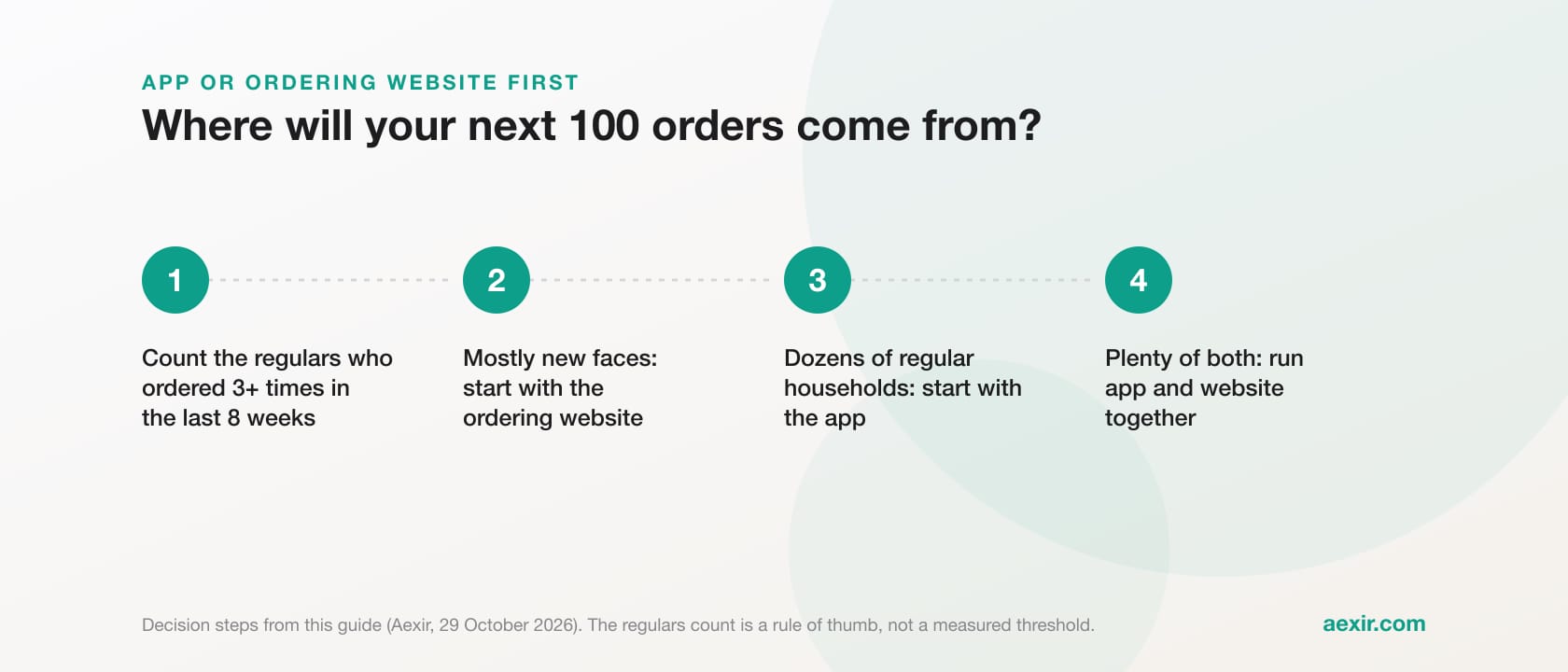
Chart: Aexir, from the figures in this article
Start with an ordering website if most of your trade is new or occasional customers who find you on Google, Instagram or a flyer. Start with an app if you already have regulars who order every week or two, because an app earns its keep by bringing back people who already know you. Run both once you have plenty of each. At Aexir’s published prices the first step costs the same either way, £30 a month ex VAT, and both together are £40. Other providers’ prices below were read from their own pages on 28 October 2026.
Short answer. Website first: new openings, passing trade, office lunches, customers arriving from Google Maps or social links. App first: established shops with regulars, repeat Friday-night trade, loyalty stamps or points. Both: a solid base of regulars plus a steady flow of new faces. Aexir: Web £30, Starter £30, Plus (both) £40 a month ex VAT, on the pricing page.
The question that decides it: first orders or repeat orders?
An ordering website and an ordering app do different jobs. A website is a door anyone can walk through: a customer taps a link on Google Maps, in your Instagram bio or in a WhatsApp reply and sees your menu, with nothing to install.
An app is a key that only your regulars carry. Someone has to download it first, but after that your shop sits one tap from their home screen, they stay signed in, and you can reach them with a notification. So the useful question is where your next hundred orders will come from: people who have never ordered from you, or people who already have.
The one published UK figure we found points the same way. In a YouGov survey published on 4 December 2019, 54% of the 18% of Brits who order fast food several times a month said they already have a particular restaurant in mind by the time they open a delivery app, against 39% of Brits in general (YouGov, “How are Brits using delivery apps?”, yougov.com/en-gb/articles/26685-how-are-brits-using-delivery-apps, checked 28 October 2026). It is an old survey about marketplace apps, not restaurants’ own apps, but frequent customers mostly arrive knowing who they want. That is who your own app is for.
What an ordering website does that an app cannot
- No download. A first-time customer orders in the same minute they find you, without installing anything for one meal.
- It sits behind every link you already have. Google lets a business add its own food ordering link to its Business Profile and mark ordering links as preferred for collection or delivery (Google Business Profile Help, “Manage online ordering options”, support.google.com/business/answer/10842217, checked 28 October 2026). The same link works in your Instagram bio and on a printed QR code.
- It can be found through search. A menu on a web page can be indexed by search engines; a menu inside an app cannot, so the app store listing is the only part of an app that search can see.
- It works on any device, including the office desktop and the old phone with no space for another app.
Our restaurant ordering website page shows what the Aexir version includes: your menu at yourname.aexir.com, the same live menu as the app, and no account needed for customers to order.
What an app does that a website cannot, or does badly
- It lives on the home screen, so the next order starts with one tap instead of a search, where a marketplace or a rival can appear first.
- It can reach the lock screen. Push notifications are the clearest practical difference. A website can send them on an iPhone only after the customer has added it to their Home Screen as a web app, which Apple’s WebKit team enabled with iOS 16.4 (WebKit blog, “Web Push for Web Apps on iOS and iPadOS”, 16 February 2023). That is an extra step to explain to every customer; an app simply asks for permission.
- It keeps the customer signed in, so their name, address and details are there next time and a repeat order takes seconds.
- It makes loyalty feel real. Stamps and points building up on the customer’s own phone are a reason to order from you rather than a marketplace (see the loyalty page).
On Aexir, loyalty stamps and points, QR table ordering, in-app order tracking and push notifications come with the app plans (Starter, Plus, Pro). The Web plan has offers, promo codes and POS on the Go, but not the loyalty scheme. The restaurant ordering app page shows the app; the feature grid is on the pricing page.
The install question, without invented numbers
How many customers will download the app? Nobody can honestly answer that for your shop, and we found no published study that does, so be wary of any install rate quoted without a source.
What can be said is where installs come from. A customer has to know your name to look for your app in a store, so a restaurant’s own app is installed by people who already know the shop: from a sticker on the bag, a poster at the counter, or the ordering website itself. That makes an app a multiplier on a customer base you already have, not a way to find a new one.
A shop with a steady base of regulars has an app audience on day one. A shop that opened last month does not yet, and a website will do more of the work while that base builds. The free order direct print kit makes QR posters, table tents and bag stickers pointing to your own ordering link.
Count your regulars before you choose. Take the last eight weeks of phone orders, card receipts or your till’s customer list and count the names or numbers that appear three times or more. Our rule of thumb, not a measured threshold: dozens of households means you have an app audience; a handful means start with the website and build the list.
Start with an ordering website if
- You opened recently and most orders come from people trying you for the first time.
- You trade on passing footfall (a station, a student area, a tourist spot) where many customers order once.
- Office lunch orders matter, and many of them are placed from a desktop.
- Most customers find you through Google Maps or social media, so a link is their natural next step.
- You are moving off GloriaFood (end of life 30 April 2027) and your order online links need somewhere to point; see the GloriaFood alternative page.
- You also need a till: Aexir’s Web plan includes POS on the Go, the till and back office in any browser.
Start with an app if
- You have traded for a while and have a core of regulars who phone in or order every week or two.
- Your trade is repeat by nature: the family Friday night, the chippy or curry house the street has used for years.
- You want to run loyalty stamps or points, or send a message on a quiet Tuesday to bring regulars back.
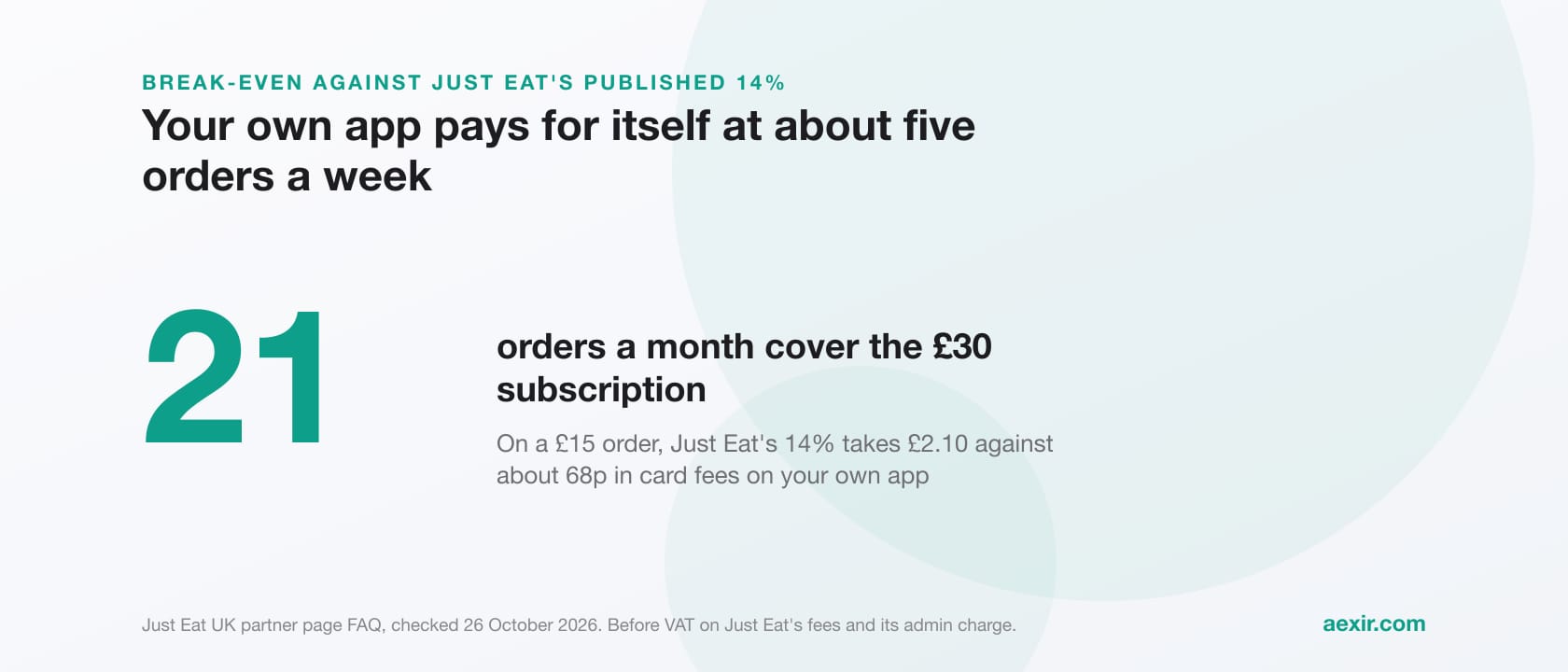
- Regulars find you on a marketplace by name and you want them ordering from you instead; the Just Eat versus your own app comparison runs the numbers.
- You want table customers to scan a QR code and order from their seat (on Aexir, an app-plan feature).
Run both if
You have regulars and a steady flow of new customers. The website takes the first order from a link; the app takes the second, third and tenth. Both should share one menu, one set of prices and one order screen, or Friday night means updating two systems.
Use the website to recruit app users: mention the app on the bag and the counter, and keep the website link on Google and social media for people who have not ordered yet. On Aexir, Plus at £40 a month ex VAT is the app and the ordering website together on the same live menu. Adding the website to Starter costs £10 a month, which comes to the same £40.
What each route costs at published prices
The table shows what eight providers publish for a website, an app and both, read from each one’s own website on 28 October 2026. Weekly prices are shown as the vendor states them, not converted. Where a vendor does not say whether VAT is included, we say so. For the whole field ranked by need, see which UK ordering system is cheapest for an app, a website or both.
| Provider | Ordering website | App | App and website together |
|---|---|---|---|
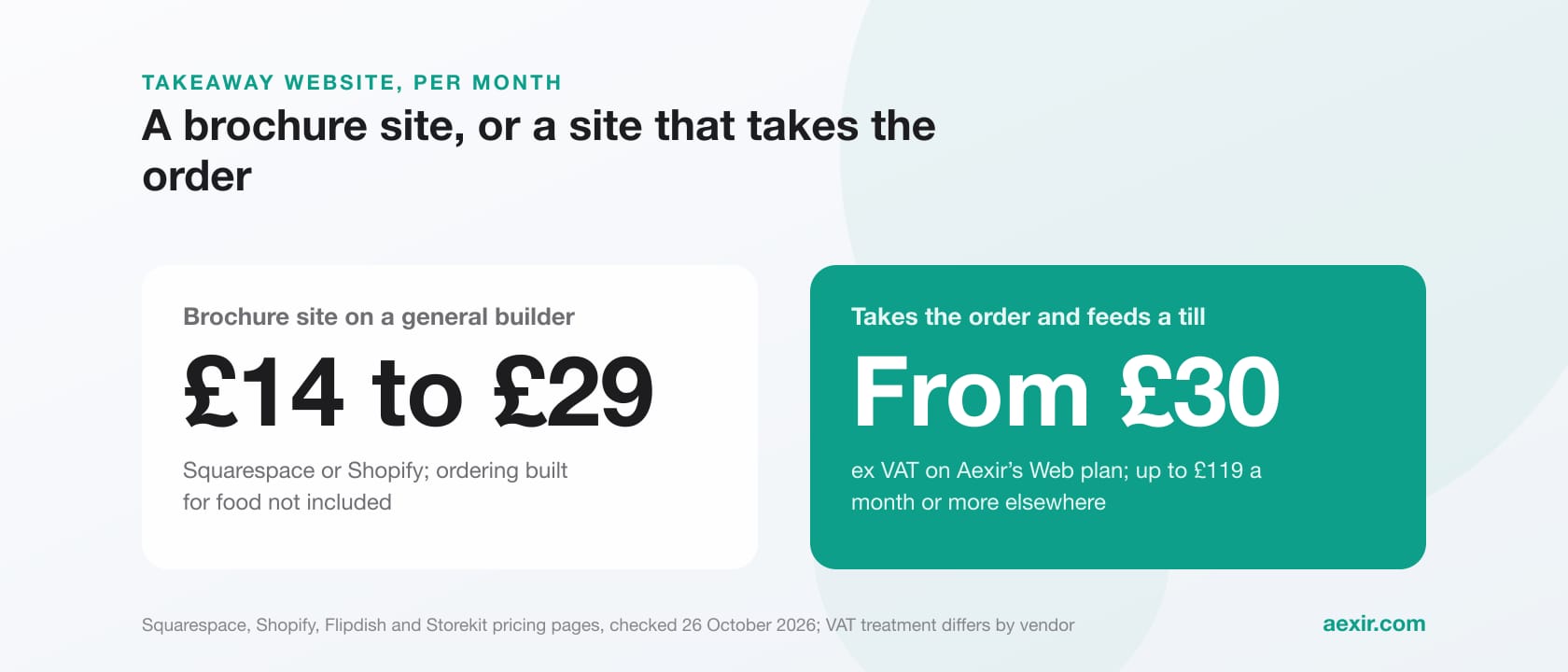
| Aexir | Web £30 a month ex VAT (website plus POS on the Go) | Starter £30 a month ex VAT (branded iOS and Android app) | Plus £40 a month ex VAT |
| Storekit | Starter free, Grow £99, Pro £199 a month per location ex VAT, plus a per-order rate (not published) | Native app (App Studio) +£99 a month, an add-on on Pro (included on Enterprise, from £995 per brand) | £298 a month per location ex VAT (Pro plus App Studio, our sum), plus the per-order rate |
| Slerp | From £125 per site per month for the web ordering tier, plus a platform fee on orders (rate not published), VAT not stated | No app-only tier stated | Up to £250 per site per month for the tier with the branded native app; £500 onboarding fee, waived if live within 30 days |
| eTakeawayMax | Silver £10 a week, VAT not stated | No app-only package listed | Gold £14.50 a week (website plus Android and iPhone apps); your own App Store accounts needed |
| Grub Direct | No website-only plan listed | No app-only plan listed | Online Ordering £7.50 a week (website plus iOS and Android app), VAT not stated |
| Flipdish | No separate price published | No separate price published | Essential from £119 a month per site billed annually, £139 billed monthly, ex VAT (website and apps with the Flipdish POS) |
| Square Online | Free £0, Plus £20, Premium £64 a month billed annually, VAT not stated | Not stated | Not stated |
| Orderzone | £49 a month or £490 a year, VAT not stated | Not stated | Not stated |
Read from each vendor’s own page on 28 October 2026: aexir.com/pricing, storekit.com/pricing, slerp.com/ai-info-page, etakeawaymax.co.uk/packages, grubdirect.co.uk/pricing, flipdish.com/gb/pricing, squareup.com/gb/en/online-store/plans, orderzone.co.uk/pricing.
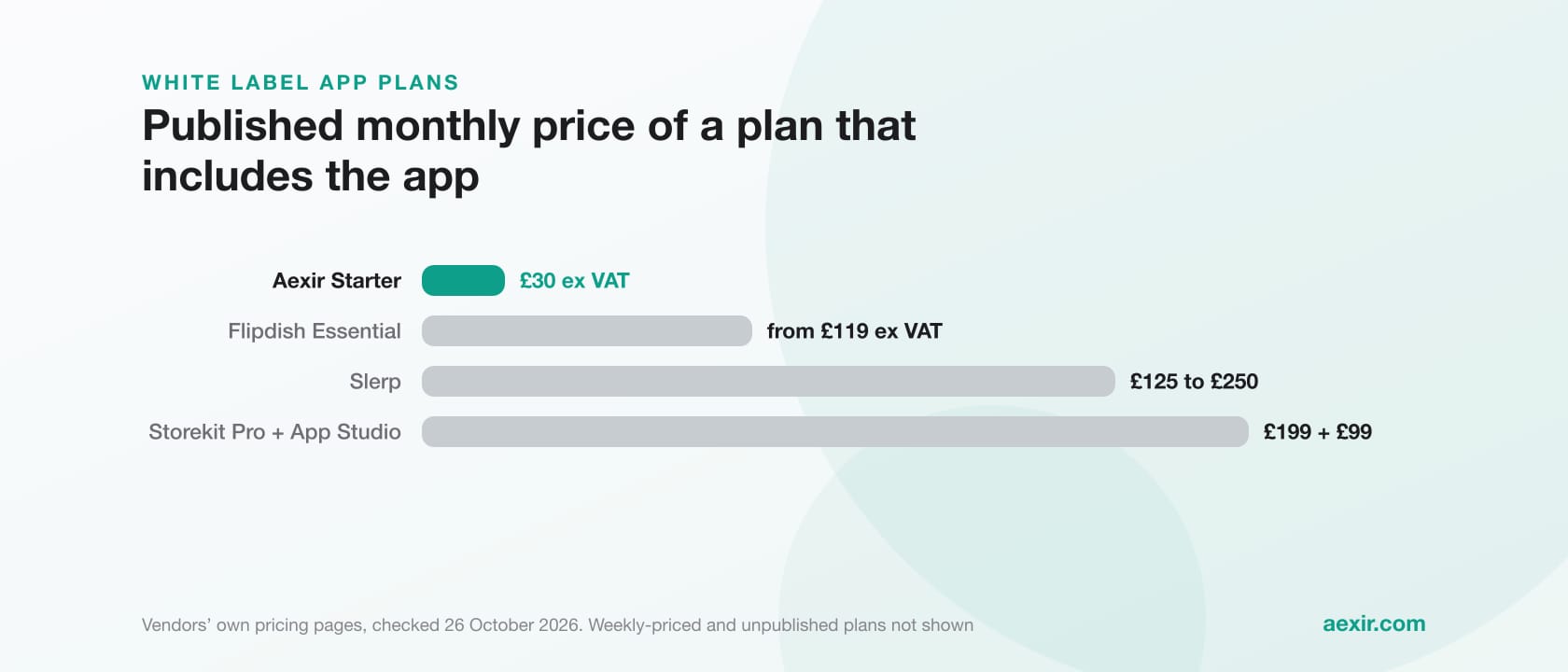
Where a provider prices the app separately, the app is the premium tier: Storekit’s native app is a £99 a month add-on to its £199 Pro plan, Slerp lists £125 to £250 a site depending on whether the native app is included, and eTakeawayMax’s Gold package with apps is £4.50 a week more than Silver. Grub Direct and Flipdish bundle the website and app at one price, and Square Online and Orderzone list no native app. At Aexir the website and the app start at the same £30 a month ex VAT, so you can choose on customers, not budget.
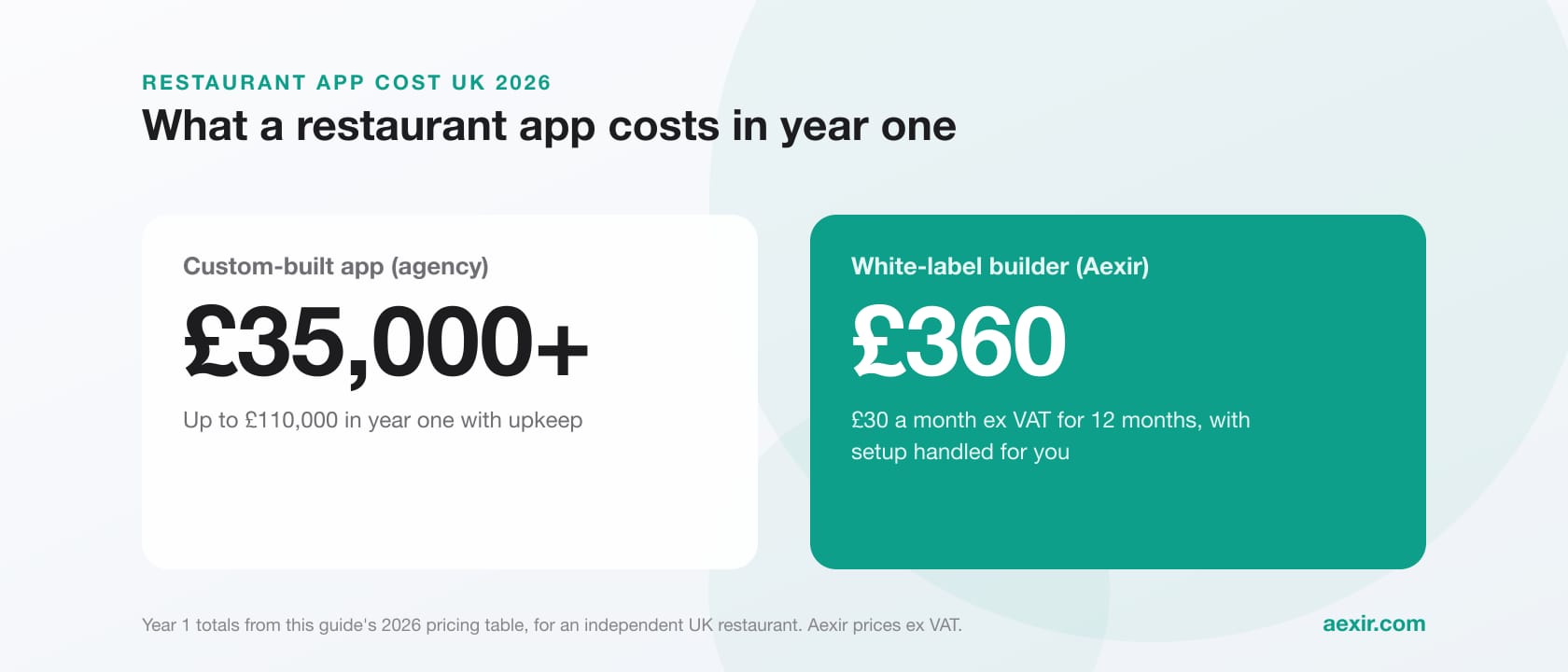
The subscription is never the whole bill. Card payments cost extra: 2.5% + 30p per transaction on Aexir in the UK, and 1.4% + 25p per UK card on Square Online’s Free and Plus plans or 1.4% + 15p on Premium. App plans also need an App Store and Google Play developer account. On Aexir that is £30 a year on Aexir’s account, or about £130 a year paid to Apple and Google if you use your own; eTakeawayMax says its customers need their own App Store accounts. More detail: takeaway website costs and restaurant app costs.
Five questions to ask any provider
- Is it one menu? A price change or a sold-out item should update the app and the website together.
- Whose name is on the app in the stores, and whose developer account publishes it?
- What do I pay per order on top of the monthly fee, card fees included? Our per-order cost breakdown shows what to add up.
- Who builds the menu, and who submits the app and its updates to Apple and Google?
- Can I add the other channel later without changing provider or rebuilding the menu?
Starting with one does not lock you out of the other
On Aexir you can start on the Web plan and move to an app plan later, or start on Starter and add the ordering website for £10 a month. One detail to plan for: POS on the Go comes with Web and Pro, so a Web customer who adds the app and wants to keep the browser till moves to Pro at £50 a month ex VAT; Plus at £40 has the app and website without it. Aexir builds the menu either way, and publishes the app when you have one.
Allow a little more time for the app. It goes through Apple’s review before it appears on the App Store; Apple says it typically reviews at least 50% of submissions in less than 24 hours and 90% in less than 48 hours (developer.apple.com/distribute/app-review, checked 28 October 2026). A website has no review step.
Compare the Web, Starter and Plus plans
Web and Starter £30, Plus £40 and Pro £50 a month ex VAT, card payments 2.5% + 30p per transaction in the UK, with the full feature grid for each plan.
See pricingTalk to a real person about switching
Common questions answered.
They do different jobs. Start with an ordering website if most orders come from new or occasional customers who find you through Google or social media, and with an app if you already have regulars who order every week or two. Shops with plenty of both run both on one menu.
Not on its own. An app is better at repeat orders: home screen icon, customer stays signed in, push notifications. A website is better at first orders: nothing to install, and it sits behind your Google, Instagram and QR code links.
On an iPhone, only after the customer adds the website to their Home Screen, which Apple enabled with iOS 16.4 in 2023. An app asks for permission in normal use, which is why push is treated as an app feature. On Aexir, push notifications go to app customers.
At Aexir the same: Web (website) and Starter (app) are both £30 a month ex VAT, and Plus with both is £40. Elsewhere the app is usually the dearer tier: on 28 October 2026 Storekit’s native app was £99 a month on top of its £199 Pro plan, and Slerp gave £125 to £250 per site depending on whether the native app is included.
Customers who already order from you will, because they have to know your name to look for the app. We know of no published study giving a reliable install rate for a single takeaway. Count your regulars, then promote the app where they see you: the bag, the receipt, the counter and your website.
Yes. On Aexir you can start on the Web plan and upgrade to the branded app later, or start with the Starter app and add the ordering website for £10 a month. To keep POS on the Go once you add the app, the plan is Pro at £50 a month ex VAT. Aexir builds the menu and publishes the app.
Build your own restaurant app.
Aexir launches branded ordering apps for UK restaurants in under 30 days. A flat monthly fee at published prices. From £1/day.