Marketing
Quiet Nights at Your Takeaway: How to Fill Monday to Wednesday with Direct Orders
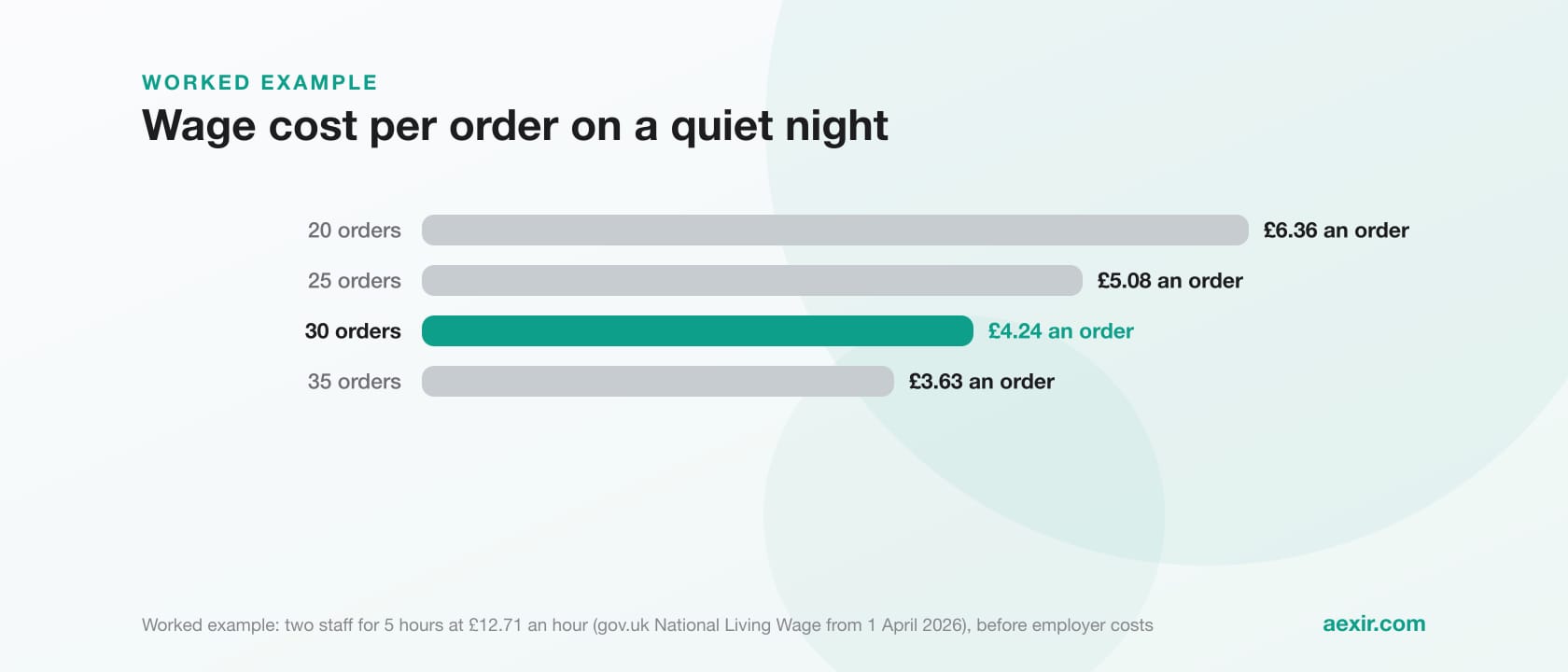
Chart: Aexir, from the figures in this article
Quiet nights are where extra orders cost a takeaway least, because the staff, the lights and the fryer are already paid for. To fill them, give customers one specific reason to order direct on that night (a midweek bundle, a collection deal, a loyalty reward or a well-timed push notification), change one thing at a time, and judge it on your own order data. Below: finding your real quiet nights, what a bundle gives away, and a four-week plan.
Short answer: count eight weeks of orders by day and hour, pick one tactic per quiet night, price it from your own food costs and compare the next four to six weeks with the same nights before. Keep what adds gross profit; drop what only discounts orders you would have had anyway.
Step 1: find out how quiet your quiet nights are
For many takeaways the quiet stretch is Monday to Wednesday, but a shop near a football ground or a campus can have a busy Tuesday and a dead Sunday. We have found no reliable published figure for which nights are quietest, so export eight weeks of orders from your till or ordering system and count:
| What to count | Split it by |
|---|---|
| Orders | Day of the week and hour |
| Sales and average order value | Day of the week |
| Channel | Your own app or website, marketplaces, phone, walk-in |
| New and returning customers | Day of the week |
| Delivery and collection | Day of the week |
Use the same eight weeks for every figure and note any bank holidays.
The channel split matters because only customers on your own channel can be reached again by push or loyalty. Write down one baseline per quiet night, the average number of orders, and judge every tactic against it. Our push notifications guide covers what to send and how often.
Step 2: work out what a quiet night costs you
Most of a quiet night’s cost is fixed: the rota, the hot fryer and the rent are the same at 20 orders or 40. Worked example, with illustrative figures: two staff aged 21 or over work a five-hour Tuesday at the National Living Wage of £12.71 an hour (the rate from 1 April 2026, rising to £13.21 in April 2027). Wages are 2 × 5 × £12.71 = £127.10, before employer National Insurance, pension and holiday pay.
| Orders on the night | Wage cost per order |
|---|---|
| 20 | £6.36 |
| 25 | £5.08 |
| 30 | £4.24 |
| 35 | £3.63 |
Worked example: £127.10 of wages divided by the night’s orders. Wage rate from gov.uk/national-minimum-wage-rates, checked 12 November 2026.
Going from 20 to 30 orders cuts the wage cost of each order by £2.12 without adding a shift. So every idea below faces one test: does it bring orders you would not otherwise have had, at a gross profit that beats what it gives away?
Midweek bundles and set menus
A bundle or short set menu hands a hesitant customer a decision already made: a meal for two, a family box, a curry night for four. Build it from dishes you already prep in volume and that travel well, and price it from food cost, not a round number.
Worked example, with illustrative figures: a Tuesday meal for two of two mains at £9.50, a side at £3.50 and two cans at £1.50, which is £25.50 at menu prices. Food cost, including packaging, is £7.40 (£2.90 a main, 70p for the side, 45p a can). The bundle sells at £21.
| Worked example | At menu prices | As the Tuesday bundle |
|---|---|---|
| Price to the customer | £25.50 | £21.00 |
| Price without VAT at 20% | £21.25 | £17.50 |
| Food cost | £7.40 | £7.40 |
| Gross profit | £13.85 | £10.10 |
| Gross profit margin | 65.2% | 57.7% |
For a VAT-registered takeaway, before card fees. Hot takeaway food is standard-rated, as are many cold drinks (HMRC VAT Notice 709/1, section 4.1); the standard rate is 20% (gov.uk/vat-rates). Both checked 12 November 2026.
Each bundle earns £3.75 less than menu prices. A regular who switches costs you that £3.75; a new order adds £10.10 on a shift already paid for. If six usual Tuesday customers switch, that is 6 × £3.75 = £22.50, so you need three new bundle orders (£22.50 ÷ £10.10 = 2.2, rounded up) just to stand still.
Cost your own dishes with the food cost calculator first. If a bundle mixes standard-rated and zero-rated items, HMRC expects you to work out the VAT on each part (section 4.7).
Advertise it honestly. Base any “save £4.50” claim on the prices customers really pay for those items on the same channel, and make sure a “Tuesday only” deal really is: the CMA’s unfair commercial practices guidance (CMA207, updated 18 November 2025) lists falsely stating that a product will only be available for a limited time among practices banned in all circumstances. A summary, not legal advice.
Collection-only offers
A collection order costs you no delivery, so a collection deal can share that saving: a free side over a set spend, a lower bundle price, or a ready time you can promise. For scale, a ten-minute round trip by a driver on £12.71 an hour is £2.12 of wages before fuel (10 ÷ 60 × £12.71).
If the driver is rostered anyway, collection saves time rather than wages, so these offers pay most when they let you roster one fewer driver. Speed is an offer too: “collect Monday to Wednesday, ready in 15 minutes” costs nothing, if the kitchen can keep it.
Loyalty that points at your quiet nights
A reward redeemed on a Tuesday uses spare capacity; on a Saturday it slows a full kitchen. Steer rewards towards the nights you need.
- On a quiet afternoon, remind members who are close to a reward: “One more order to your free side.”
- If your loyalty set-up lets you limit when rewards can be used, make one redeemable Monday to Wednesday only, and say so before customers start collecting.
- Never test a loyalty push and a new bundle on the same night in the same weeks, or you will not know which one worked.
Stamp tiers, points and reward choices are covered in restaurant loyalty programme ideas.
Timed push notifications
A push notification reaches a customer’s phone at no cost per send. Timing is what you test: for an evening takeaway, try a late-afternoon send (around 16:30 to 17:30) against one nearer opening, a few weeks each, and keep the time that brings more orders.
- One push per quiet night, two a week at most. Google notes that Android users can see how many notifications an app sends each day and can revoke permission at any time.
- Be specific: “Tuesday: meal for two £21, collection or delivery, until 9pm” beats “Hungry? Order now.”
- Send at the same time each week and point it at an offer on your own app and website, so the order and the customer stay with you.
Promotional pushes need consent: Apple’s App Store Review Guideline 4.5.4 says pushes should not be used for promotions unless customers explicitly opted in through consent language in your app, with an in-app way to opt out. Marketing texts and emails need consent or the ICO’s soft opt-in; see GDPR for takeaways.
Student nights and local-business nights
A theme night gives a group a reason to order together on a night they would otherwise cook.
- Student night: one fixed night a week with a group bundle at a clean price per head. Winning student customers at freshers covers the start of term; a weekly night keeps them ordering after it.
- Local-business night: hospitals, care homes, warehouses and taxi offices work evenings. Drop off an A4 sheet with a group deal and a cut-off (orders in by 6pm, delivered at 7pm).
- Clubs and pubs: five-a-side leagues and pubs with no kitchen on quiz night. Offer the organiser a set menu at a fixed price per head.
Give each night its own bundle name so you can count it in your order data. For ideas not tied to one night, see 15 takeaway marketing ideas.
Run a shorter menu on quiet nights
A full menu on a 20-order night means every station prepped and more waste at close. Check which dishes your quiet-night orders actually contain, run those plus the bundle, and switch off dishes that need their own prep line or a long cook. Tell customers in the app and on the website which nights run the shorter menu.
Keep allergen information right for every dish, including a new bundle or special. FSA guidance says that for online and phone orders it must be available before the purchase is completed and again at delivery, and that you need to consider the impact when recipes change.
On marketplaces, commission comes off any discounted price too. The menu markup calculator shows what a dish must sell for on Just Eat, Deliveroo or Uber Eats to match your own menu price.
Staffing and prep on quiet nights
- Roster from the hourly counts. If Monday’s first hour takes two orders, one person can open and a second start later.
- Prep to the average of the last four same nights, plus what you expect the offer to bring, and write the prep sheet down.
- Use quiet time for jobs that pay off on Friday: batch sauces within their checked shelf life, deep cleaning, training, testing a new dish as the special.
- If Monday’s last hour takes almost nothing week after week, closing earlier may save more than any offer earns.
Measure what worked with your own order data
Run one change per night for four to six weeks and compare it with the baseline for the same night: Tuesday with Tuesday, never with Friday.
| Measure | How to work it out |
|---|---|
| Extra orders | Average orders on the night during the test, minus the baseline |
| Gross profit on the night | Sales without VAT, minus food cost, for the whole night |
| Offer take-up | Orders that used the offer, as a share of the night’s orders |
| New customers | Customers whose first order fell on the test night |
| Repeat within 30 days | Test-night customers who ordered again, on any night, within 30 days |
| Busy nights | Orders on your busy nights over the same weeks, in case you filled Tuesday by emptying Thursday |
Note anything unusual in the test weeks: a bank holiday, a big match, school holidays or a payday week.
Keep a tactic if gross profit on the night rises by more than any extra cost it added. If take-up is high but orders and gross profit are flat, regulars are simply buying at a discount: change it or drop it.
A four-week quiet-night plan
- Week 1: export eight weeks of orders, set a baseline per quiet night and cost one bundle.
- Week 2: launch the bundle on your quietest night, with one push at the same time each week.
- Week 3: add a collection offer or a local-business night on your second quietest night.
- Week 4: trim the menu and rota on both nights, then let each test run its full four to six weeks.
Where Aexir fits
Aexir gives a takeaway its own branded iOS and Android app and ordering website, with loyalty and push notifications built in, plus a POS. The pricing page shows what each plan includes, or book a 15-minute call to talk through your quiet nights.
Fill quiet nights through your own channel
A branded app and ordering website under your name, with loyalty and push notifications built in. Plans are £30, £40 and £50 a month ex VAT at published prices.
See pricingTalk to a real person about switching
Sources
- GOV.UK, National Minimum Wage and National Living Wage rates: https://www.gov.uk/national-minimum-wage-rates (checked 12 November 2026)
- HMRC, Catering, takeaway food and VAT (VAT Notice 709/1), sections 4.1 and 4.7, updated 8 June 2026: https://www.gov.uk/guidance/catering-takeaway-food-and-vat-notice-7091 (checked 12 November 2026)
- GOV.UK, VAT rates: https://www.gov.uk/vat-rates (checked 12 November 2026)
- CMA, Unfair commercial practices (CMA207), updated 18 November 2025: https://www.gov.uk/government/publications/unfair-commercial-practices-cma207/unfair-commercial-practices (checked 12 November 2026)
- Apple, App Store Review Guidelines, guideline 4.5.4: https://developer.apple.com/app-store/review/guidelines/ (checked 12 November 2026)
- Android Developers, Notification runtime permission: https://developer.android.com/develop/ui/views/notifications/notification-permission (checked 12 November 2026)
- ICO, Guide to PECR, electronic mail marketing: https://ico.org.uk/for-organisations/direct-marketing-and-privacy-and-electronic-communications/guide-to-pecr/electronic-and-telephone-marketing/electronic-mail-marketing/ (checked 12 November 2026)
- Food Standards Agency, Allergen guidance for food businesses, updated 17 July 2026: https://www.gov.uk/government/publications/allergen-guidance-for-food-businesses/allergen-guidance-for-food-businesses (checked 12 November 2026)
Common questions answered.
For many takeaways it is Monday to Wednesday, but it depends on the area. Export eight weeks of orders and count them by day and hour; your own data beats any rule of thumb.
Only if they bring orders you would not otherwise have had. In our worked example, a £21 meal for two earns £3.75 less gross profit than menu prices, so six regulars switching to it need three new bundle orders to break even.
Before customers decide what to eat: test a late-afternoon send against one nearer opening and keep the better time. Send at most one per quiet night and two a week, only to customers who opted in.
Compare four to six weeks of the test night with the baseline for the same night: extra orders, gross profit, take-up, new customers and 30-day repeat orders. Check busy nights too, in case orders simply moved.

Build your own restaurant app.
Aexir launches branded ordering apps for restaurants in under 30 days. Sets up restaurants in the UK, France and worldwide; prices in £ or € only. A flat monthly fee at published prices. From £1/day.
Prefer to do it yourself? Choose your plan, design your app and website, then sign and pay in one step. Build it yourself today